Chico Open Chico

Help

How each part of Chico works. Search for what you are stuck on, or pick a feature.

Getting started

Setting Chico up, and what the eight steps are actually asking for.

What Chico is for#

Chico holds the things you would otherwise carry in your head: the last dose, the nap, what goes in the bag on Friday, what they are allergic to. Everyone looking after your child sees the same page.

It is not a competing calendar. It covers the child’s day — the routine, health, school, meals — and leaves the rest of your life where it already lives.

The setup, step by step#

Setup is eight steps. You can leave at any point with Later and pick it up from the Finish setting up card on Today — nothing is lost, and you land back on the step you stopped at.

Only two steps really need you: the child, and the weight. Everything else can be left empty and filled in later.

  1. Your familyName the family. This is what a helper sees when they join.
  2. Your childName, birthday, and whether they are at school. The birthday sets which quick-log buttons you get — a newborn gets bottles and nappies, a four-year-old does not.
  3. Allergies and medicinesA weight, and anything they react to. The weight is what the dose calculator works from, so without it Chico will not offer a number. Roughly is fine. Allergies here are what every recipe gets checked against.
  4. Pick a routineChoose a starting shape for the day. It is a starting point, not a commitment — you edit it under Routines afterwards, and you can leave it empty and let the day happen.
  5. Anyone elseAdd another child, or skip. You can add one any time under Settings.
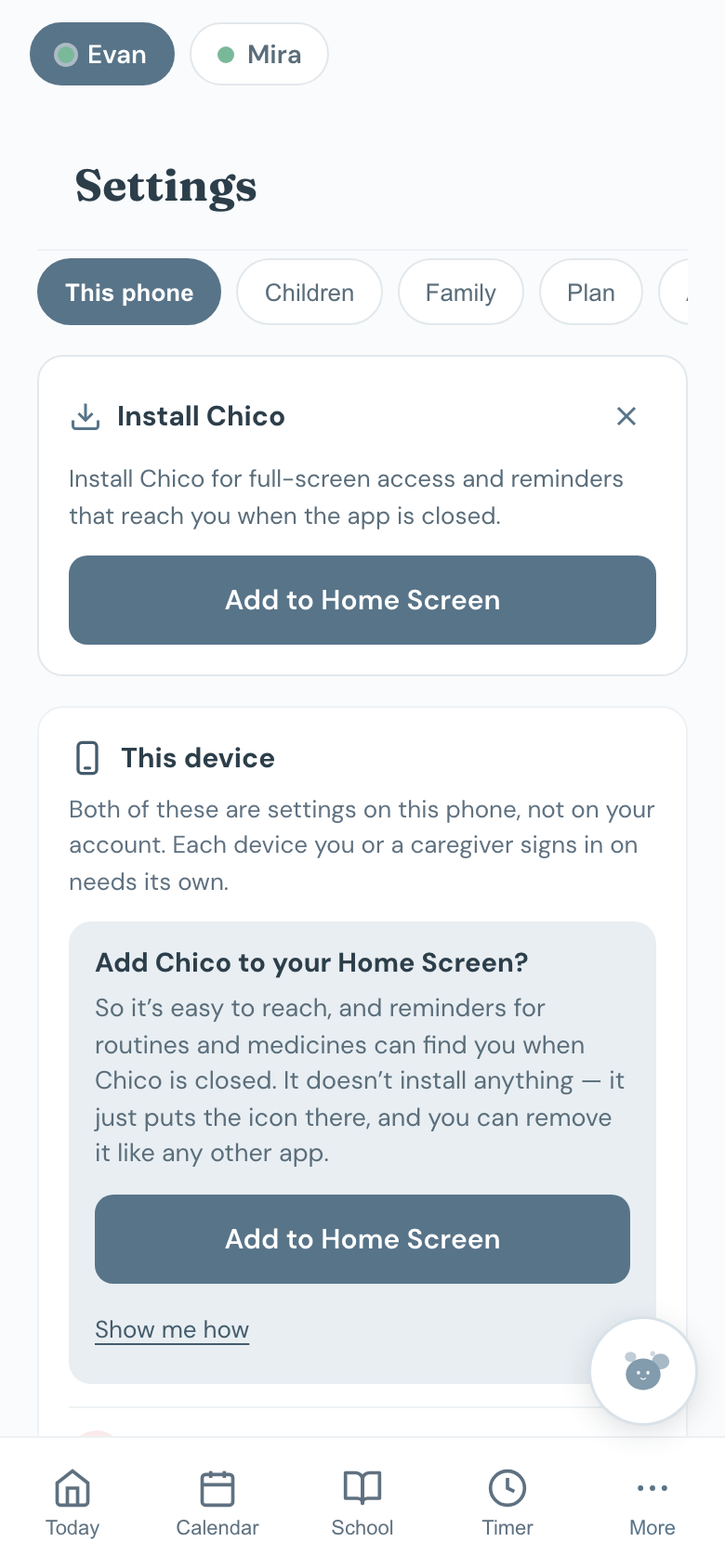
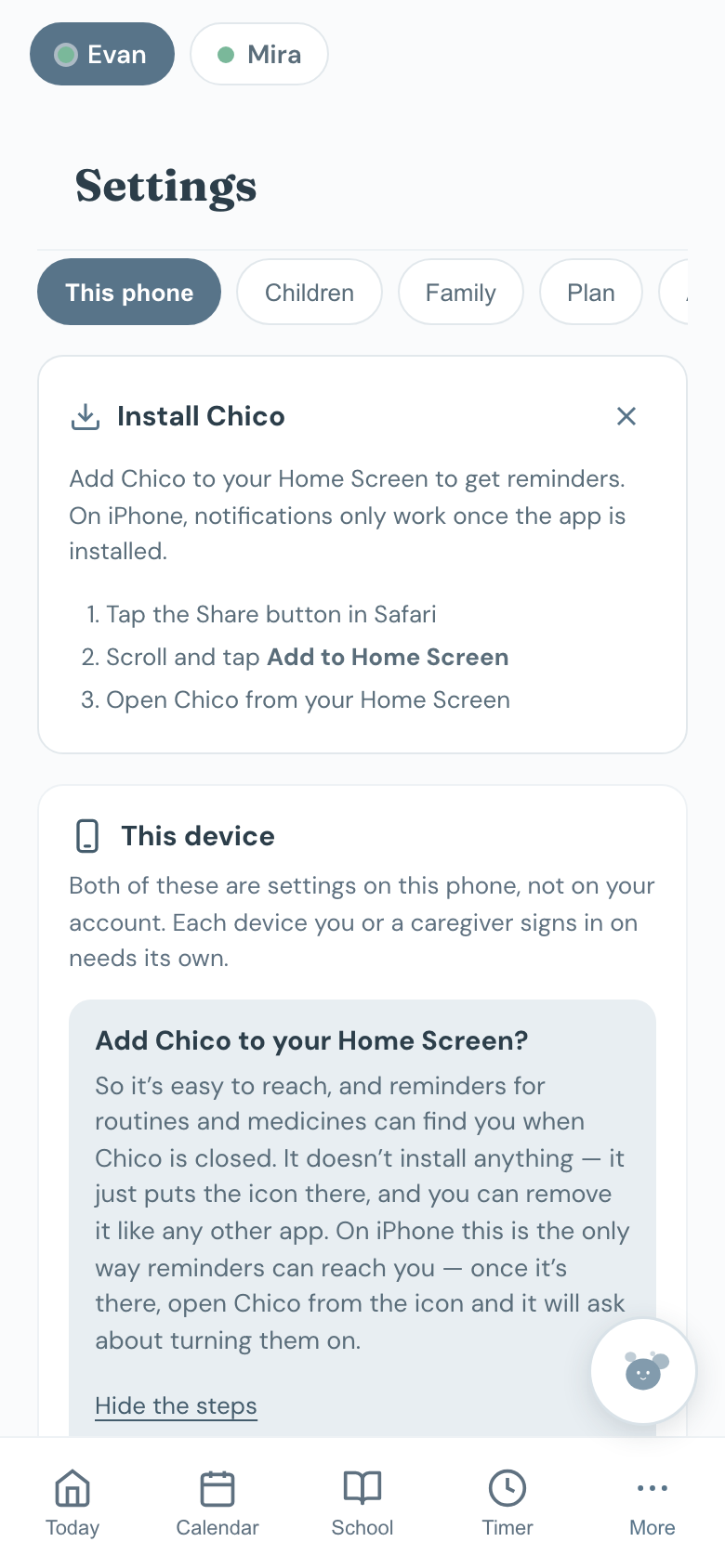
  6. This phoneThe language Chico AI replies in, adding Chico to your Home Screen, and turning reminders on. All three belong to this phone, not your account — everyone who joins sets their own.
  7. InviteShare a code so your partner or a helper joins the same family. Skippable; the codes live under Settings afterwards.
  8. You’re all setA short tour, if you want one.
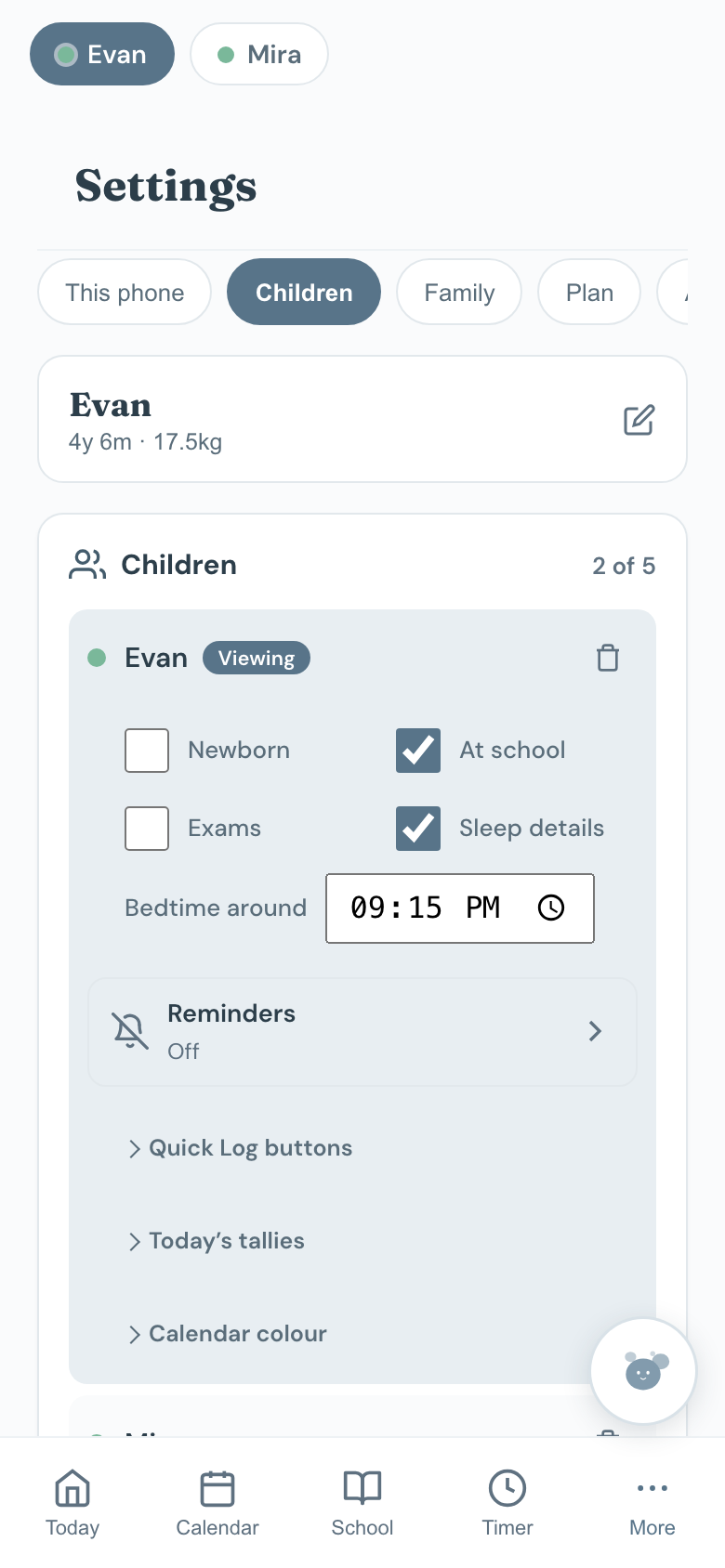
The Children section of Settings, where everything the setup asked for can be changed later.

Adding another child#

Settings › Children › Add a child. Each child gets their own routine, health record, lists and reminders.

You switch between them with the name pills at the top of every screen. What a child does not use stays hidden — a newborn with school switched off never shows a School tab.

The Children section of Settings, with a card per child.

Putting Chico on your Home Screen#

It does not install anything. It puts the icon on your Home Screen, and you remove it by dragging it off like any other app.

It is worth doing for two reasons: Chico opens full screen and works offline, and reminders can reach you when it is closed.

On iPhone this is the only way reminders can reach you — Safari will not send them until Chico is on the Home Screen. Add it, then open Chico from the icon and it will ask about turning them on.

  1. iPhoneTap the Share button in Safari, scroll and tap Add to Home Screen, then open Chico from the icon.
  2. AndroidOpen the browser menu (the three dots), tap Install app or Add to Home screen, then open Chico from the icon.
Settings, with This phone holding the language, the Home Screen card and notifications.

Why Chico is not in the App Store#

Chico is a web app, and that is a deliberate choice. It means one Chico for everyone — iPhone, Android, a laptop, a grandparent's old tablet — instead of two apps where one is always behind.

It also means I can fix something the day you tell me about it. There is no review queue and nothing for you to update: you open Chico and it is already the new version.

It does everything a store app does. It sits on your Home Screen with its own icon, opens full screen, works offline, and sends reminders. Your data is held in the same place either way.

Two things to do once, and then there is no difference you will notice: add Chico to your Home Screen, and say yes to notifications. On iPhone the first is what makes the second possible.

Today

The screen you land on: what is next, and logging what just happened.

What is on Today#

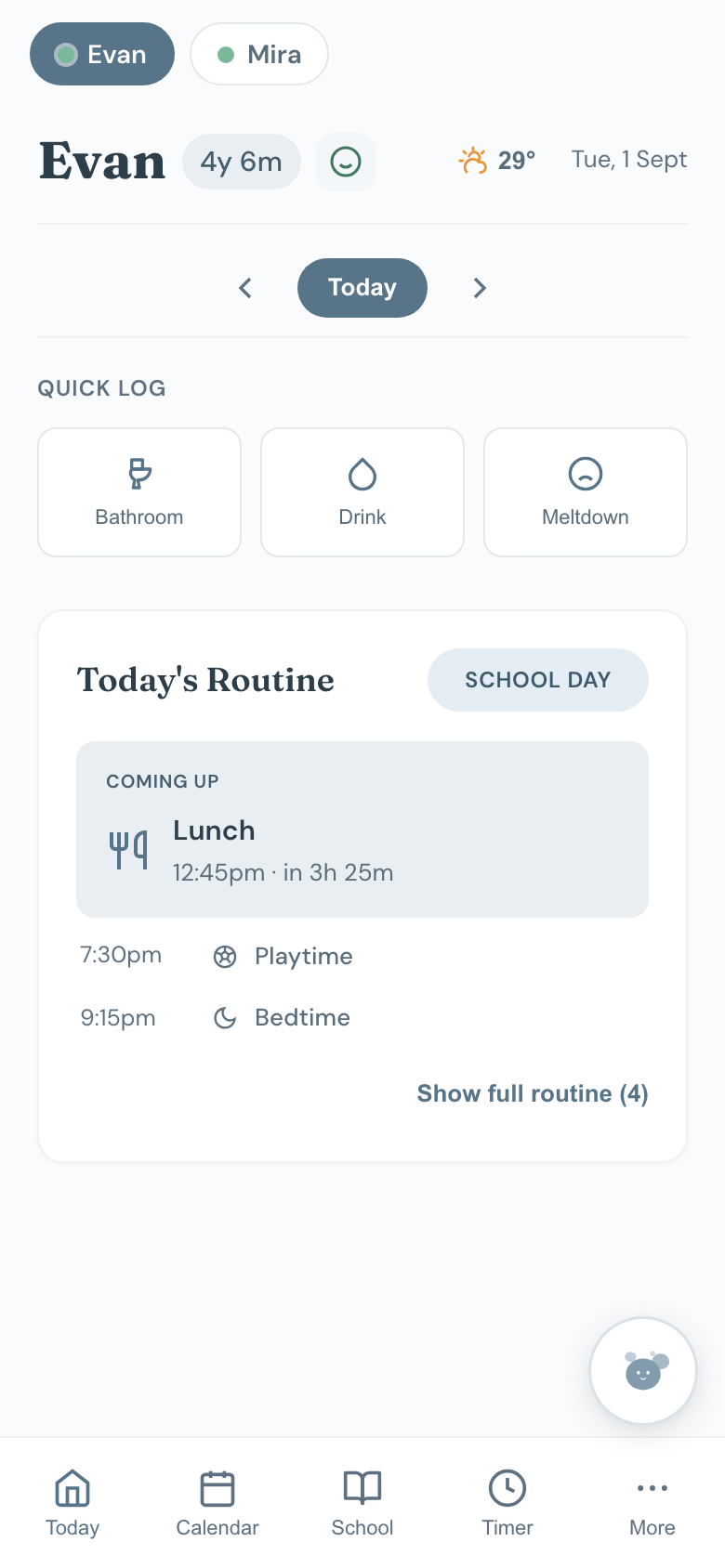
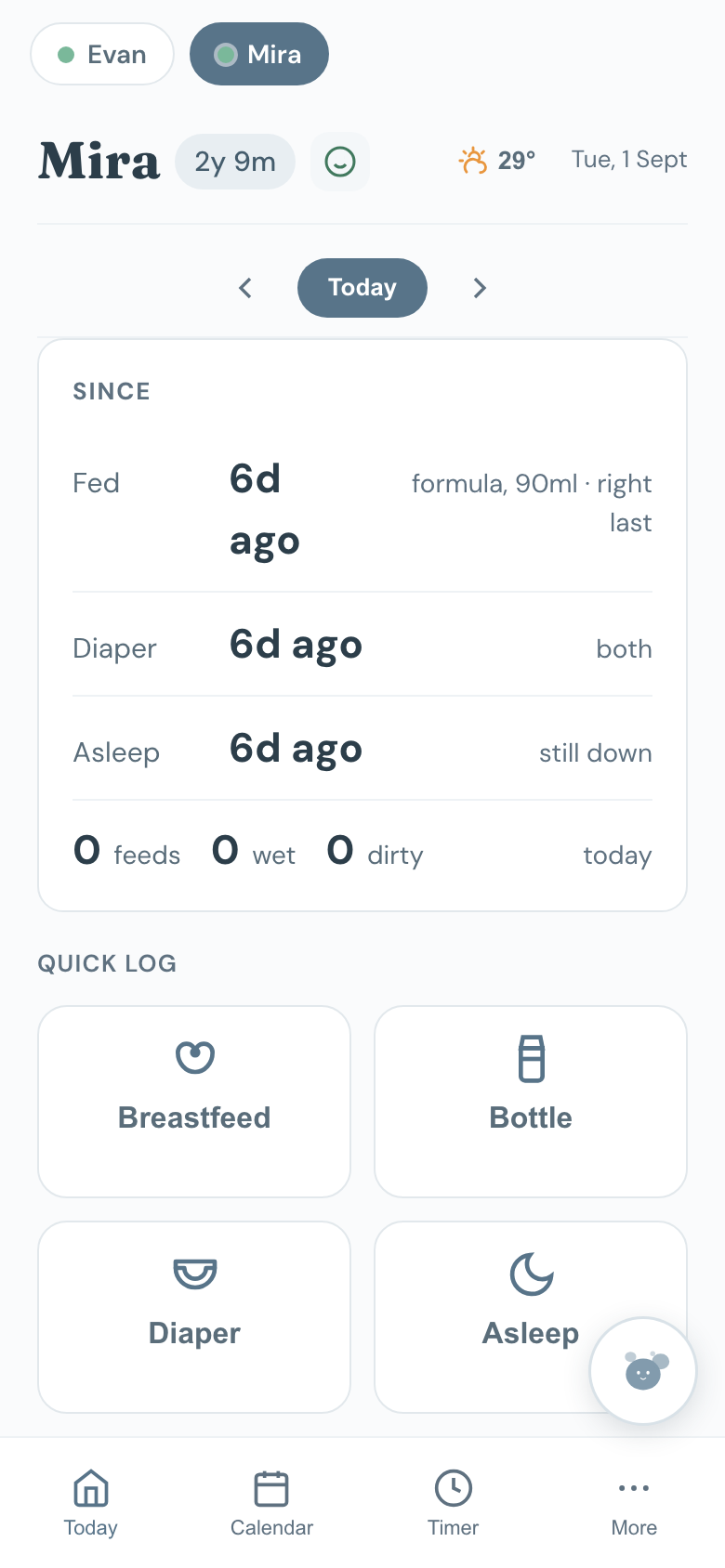
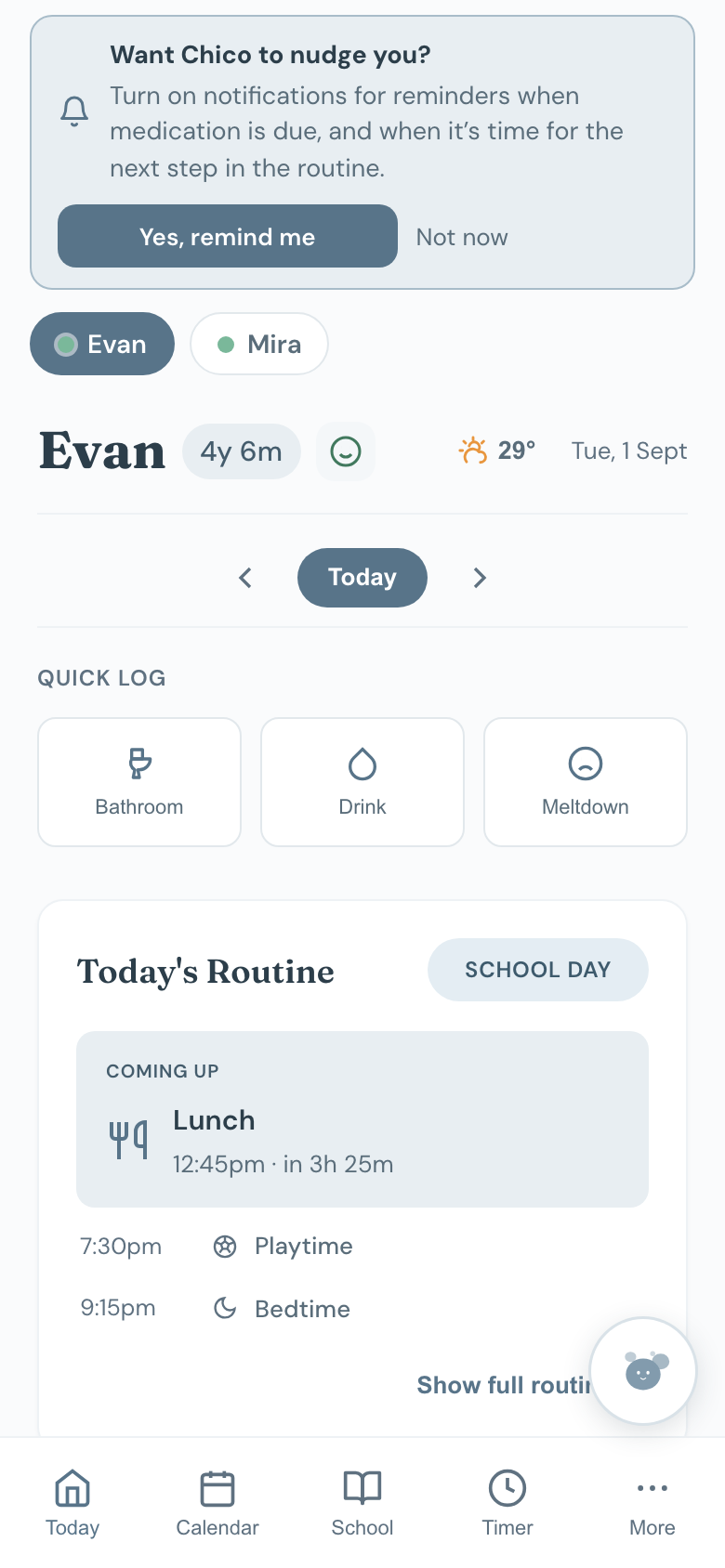
Today shows what is coming up in the routine, anything due from School, Activities or Exams, and the quick-log buttons for right now.

The arrows beside Today step back and forward a day, so you can fill in last night or look at tomorrow.

The Today screen with quick-log buttons and the routine.

The quick-log buttons#

One tap logs the thing and the time. Which buttons you see depends on the child’s age and on what is happening now.

Four of them come and go with the moment: Nap, Asleep, Bath and Fed appear half an hour before that part of the routine, stay twenty minutes past it, and go once you have tapped them. Fed stops appearing after bedtime until 5am.

You choose which buttons you want under Settings › Children › Quick Log buttons. Nothing is lost by switching one off — you can still log it from the activity screen, or by telling Chico AI.

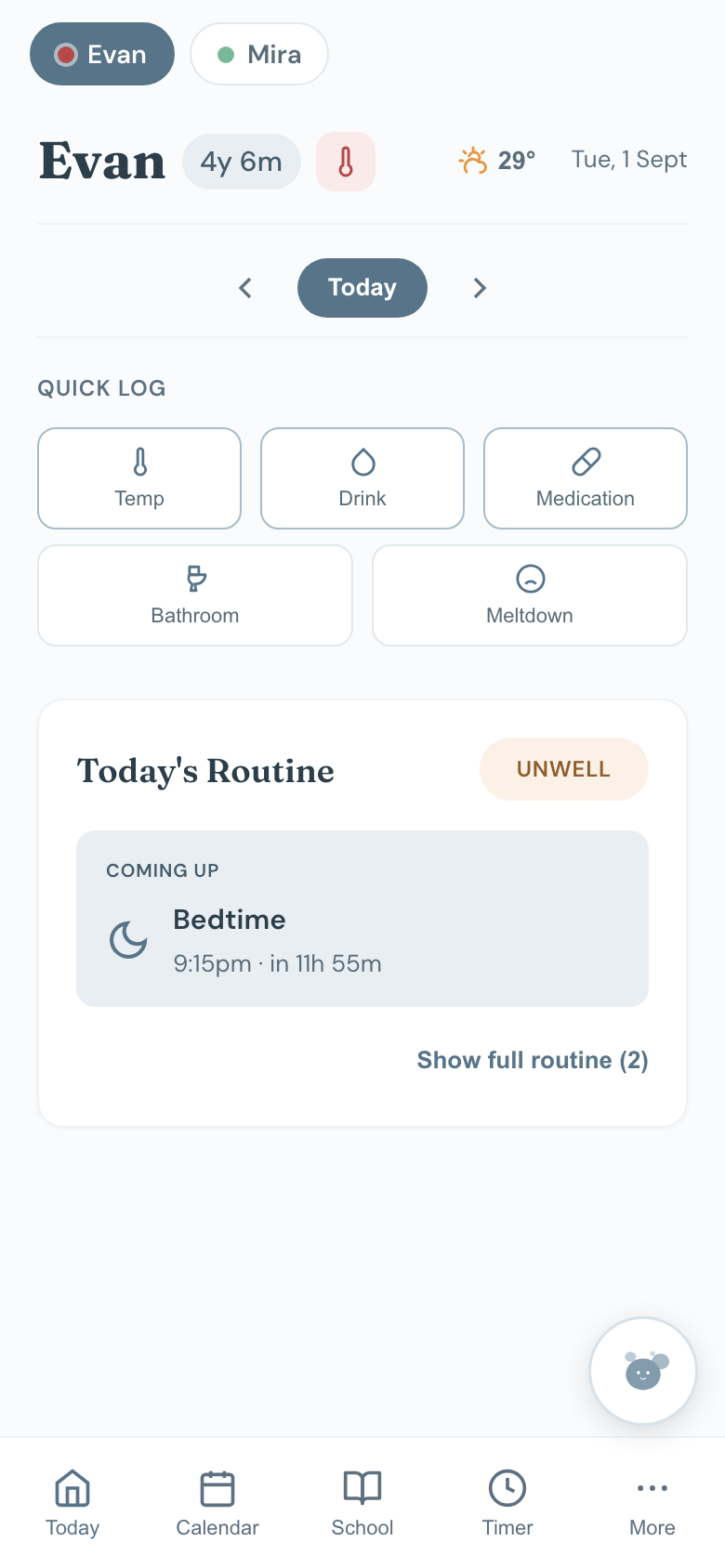
Today with the unwell quick-log buttons showing temperature and medication.

Marking someone unwell#

Tap the face beside their name on Today. An unwell day follows the rest-day routine instead of the school one, and the quick-log buttons change to the ones you want when somebody is ill — temperature, medication, drinks.

It switches back on its own when you mark them well.

Today for a newborn, with bottle and nappy buttons instead of the older child’s.

Routines

The shape of a day, and how each day of the week can differ.

Building a day#

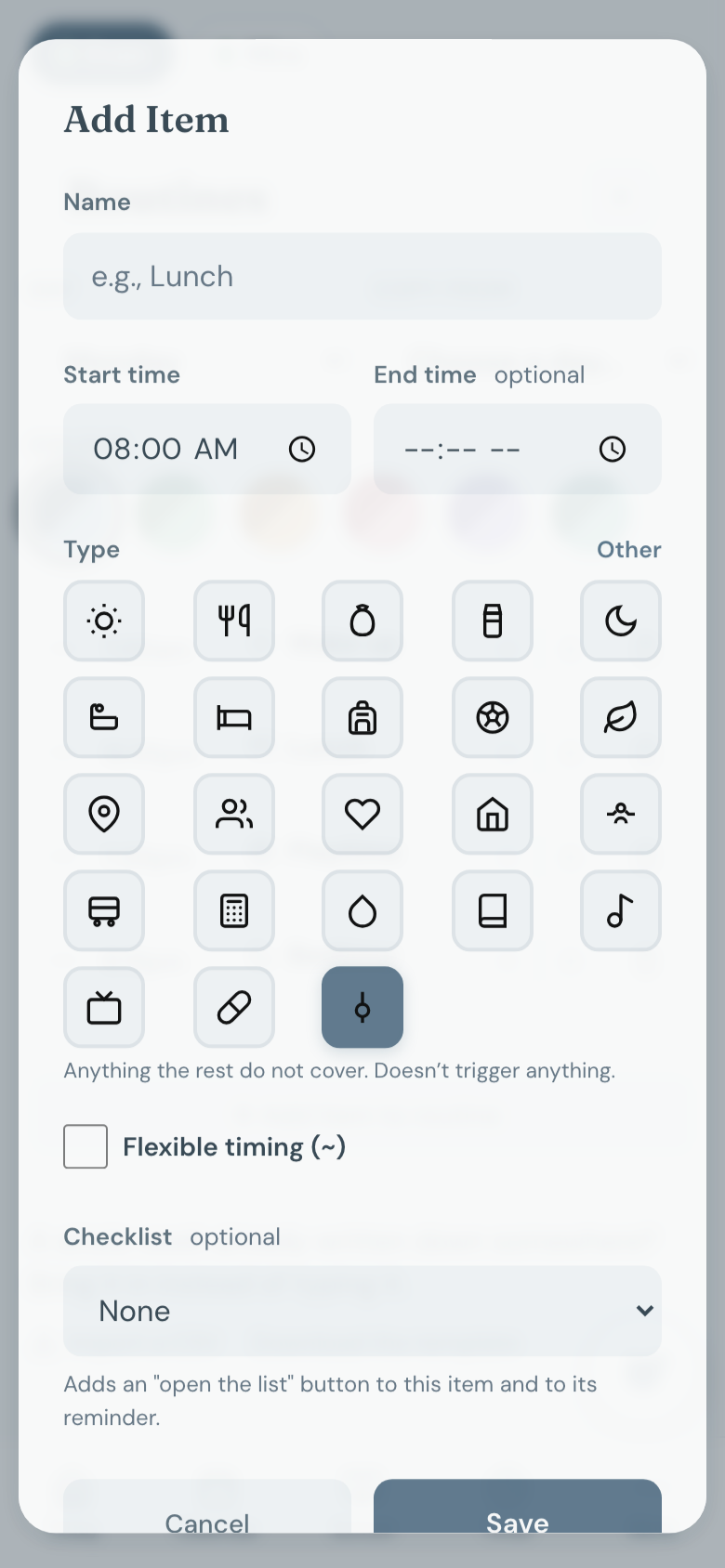
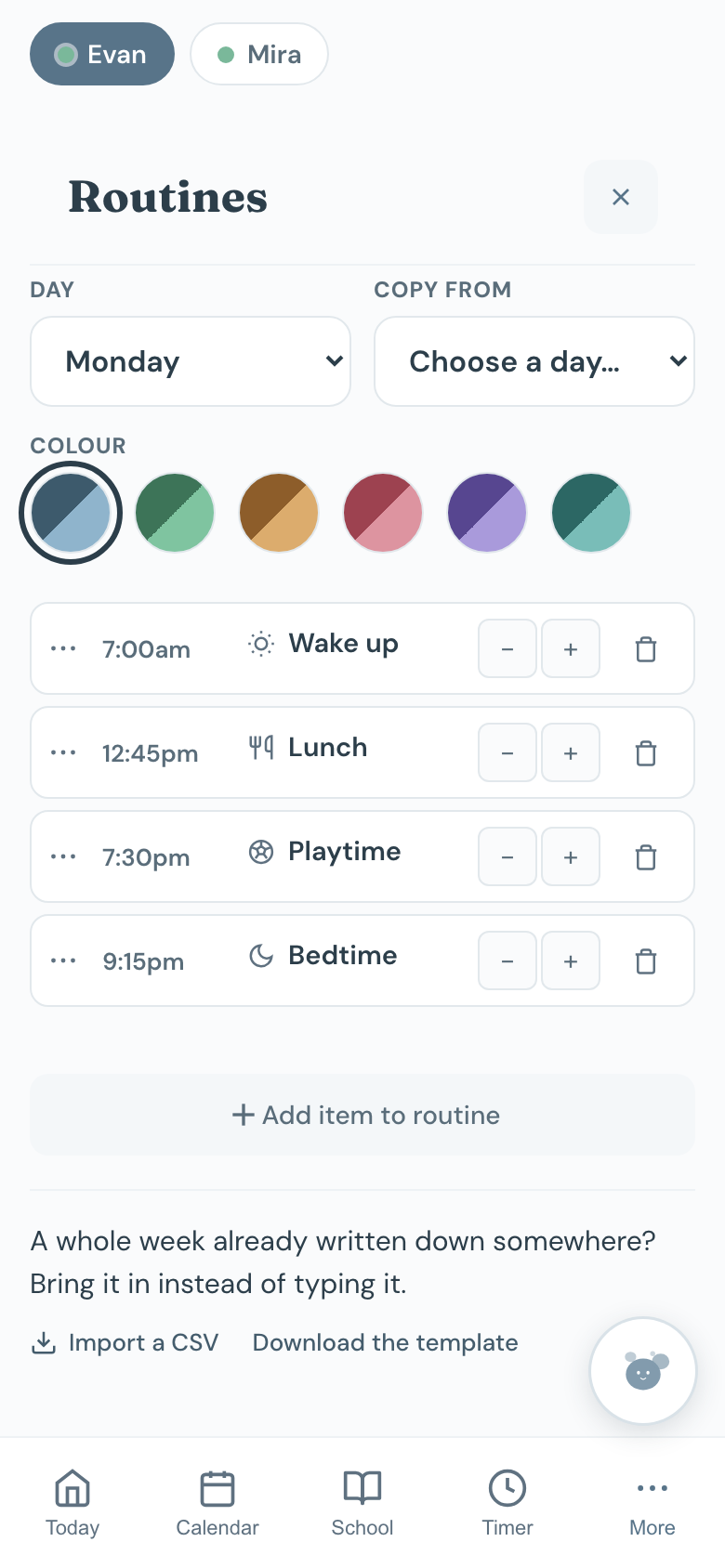
Routines › pick a day from the Day dropdown, then add rows to it. Each row is a time and a name, and a type that decides what it triggers — a Meal row brings up the Fed button, a Bedtime row starts the sleep record.

Give each day its own colour so you can tell them apart at a glance on Today.

The Routines screen with a Day dropdown, Copy from, and colour swatches.

Making the weekdays match#

If Monday to Friday are largely the same, build one and use Copy from on each of the others. It takes that day’s rows; it does not change its colour.

Each day is its own from then on, so changing Tuesday leaves Monday alone.

The rest day#

The rest day is the last entry in the Day dropdown, and four kinds of day follow it: a sick day, a day you marked no school, a term break, and a public holiday.

Saturday and Sunday are not among them — they were never school days, so a term break leaves Saturday swimming where it is.

Bringing a week in from a spreadsheet#

If the week is already written down somewhere, Routines › Download the template, fill it in, then Import a CSV. You see what it will do before anything changes, and you can undo it straight afterwards.

Give every routine at least one day in the Days column. A routine with no day cannot be opened once it is in.

School and Activities

Homework, projects, dress-up days, and everything outside school.

Adding something with a date#

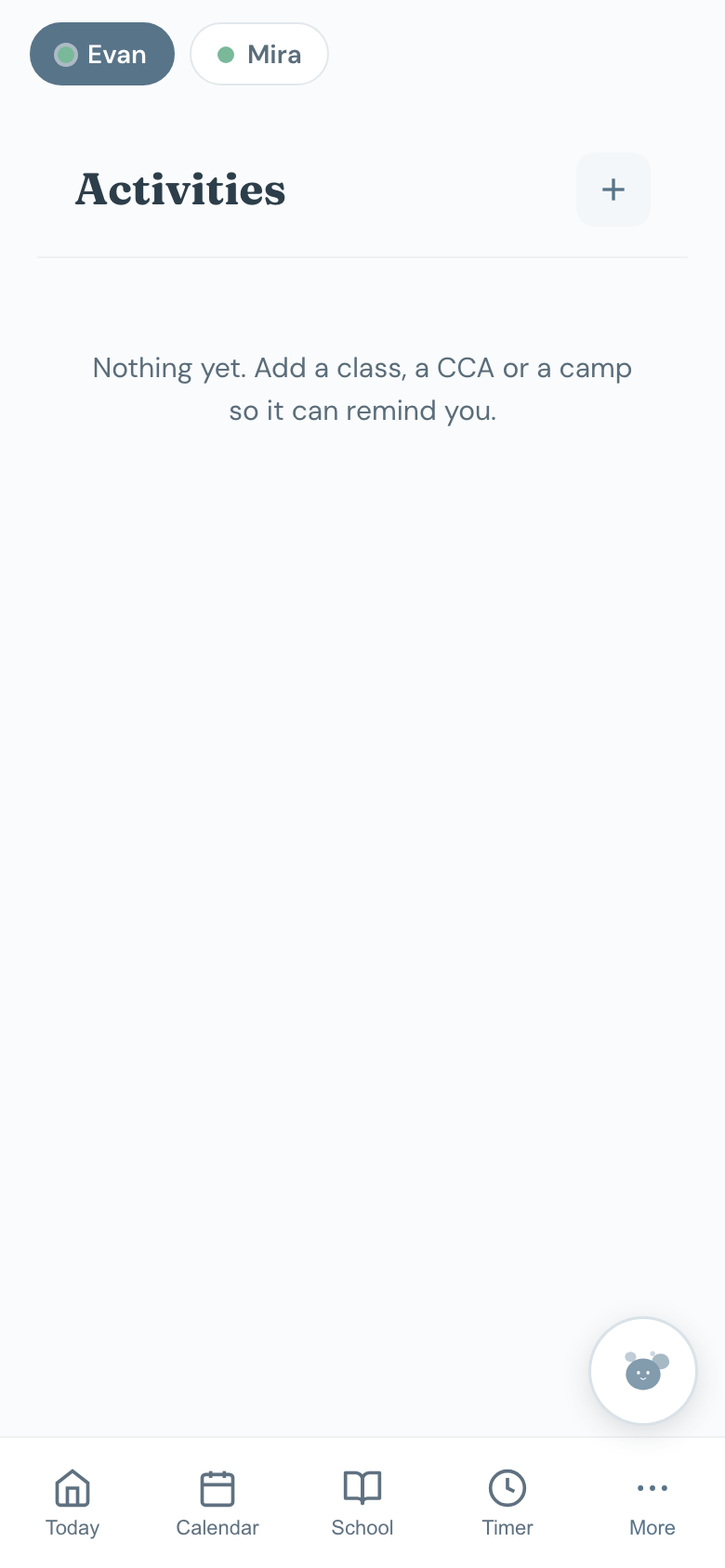
School holds what school sets — homework, projects, events, dress-up days. Activities holds everything outside it: tuition, swim class, a holiday camp.

Both take a title, a date and a time, and both can repeat. Reminders come the night before and on the morning, and you can switch either off per item.

Adding a school item, with its type, date and reminders.

Activities, and how it differs from School#

Anything outside school hours goes in Activities: tuition, swim class, a holiday camp. Anything the school sets goes in School.

They behave the same way — dates, repeats, reminders — but keeping them apart is what stops a Tuesday tuition class reading as homework.

The Activities tab with classes and camps.

Pausing something that repeats#

Open the item and switch on Paused, with an end date if you know it. It stops appearing on Today and in your Google Calendar for that stretch, then comes back on its own.

Use it for a class that stops for the holidays. Deleting and rebuilding it loses the history.

Term breaks and no-school days#

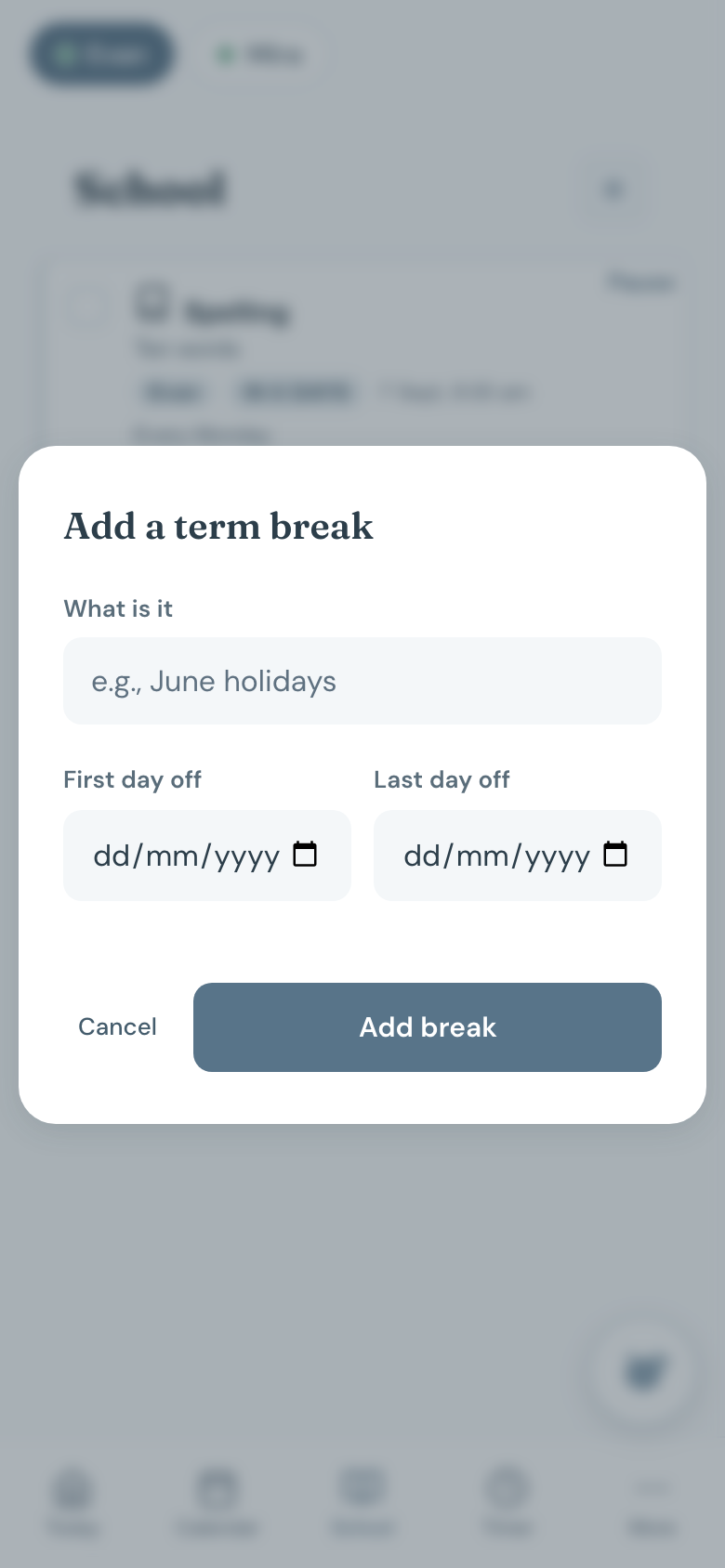
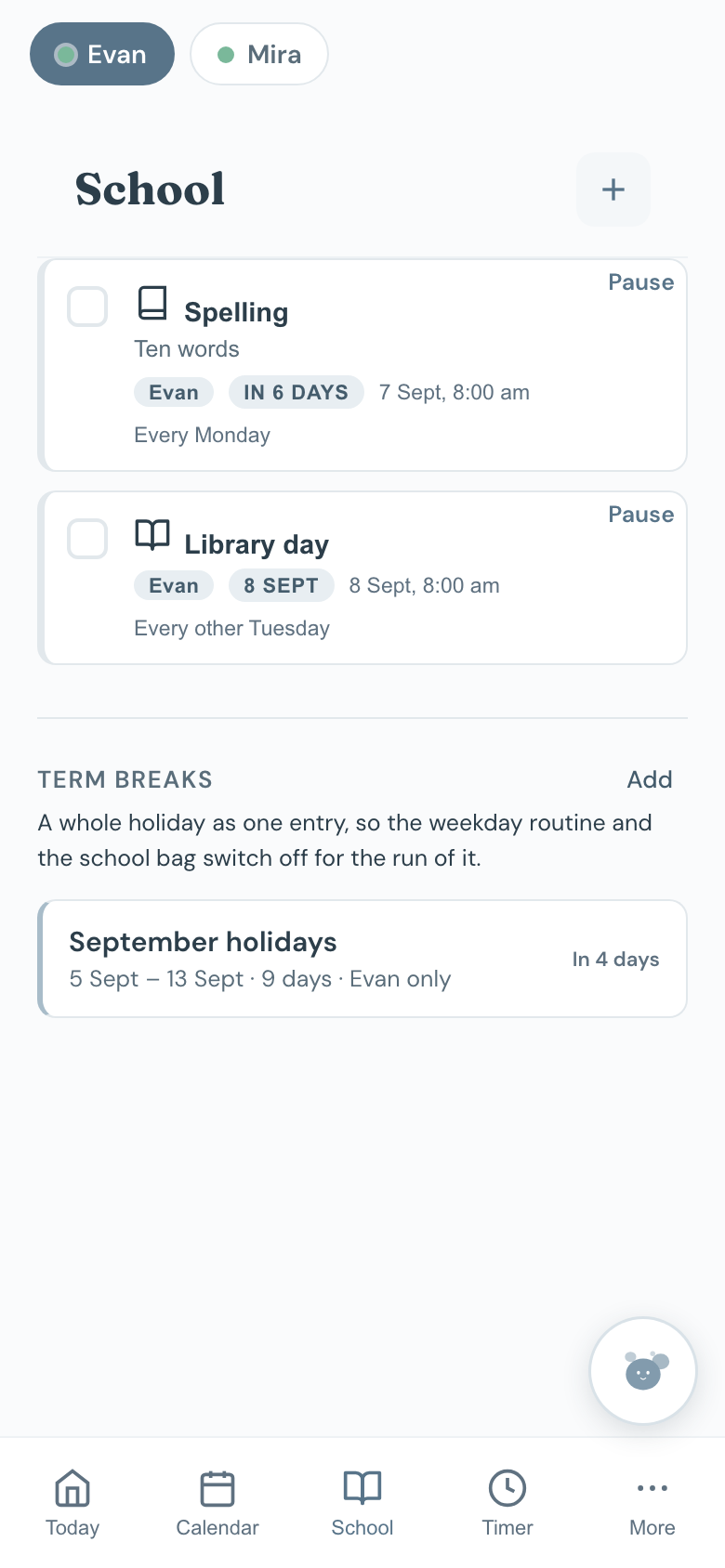
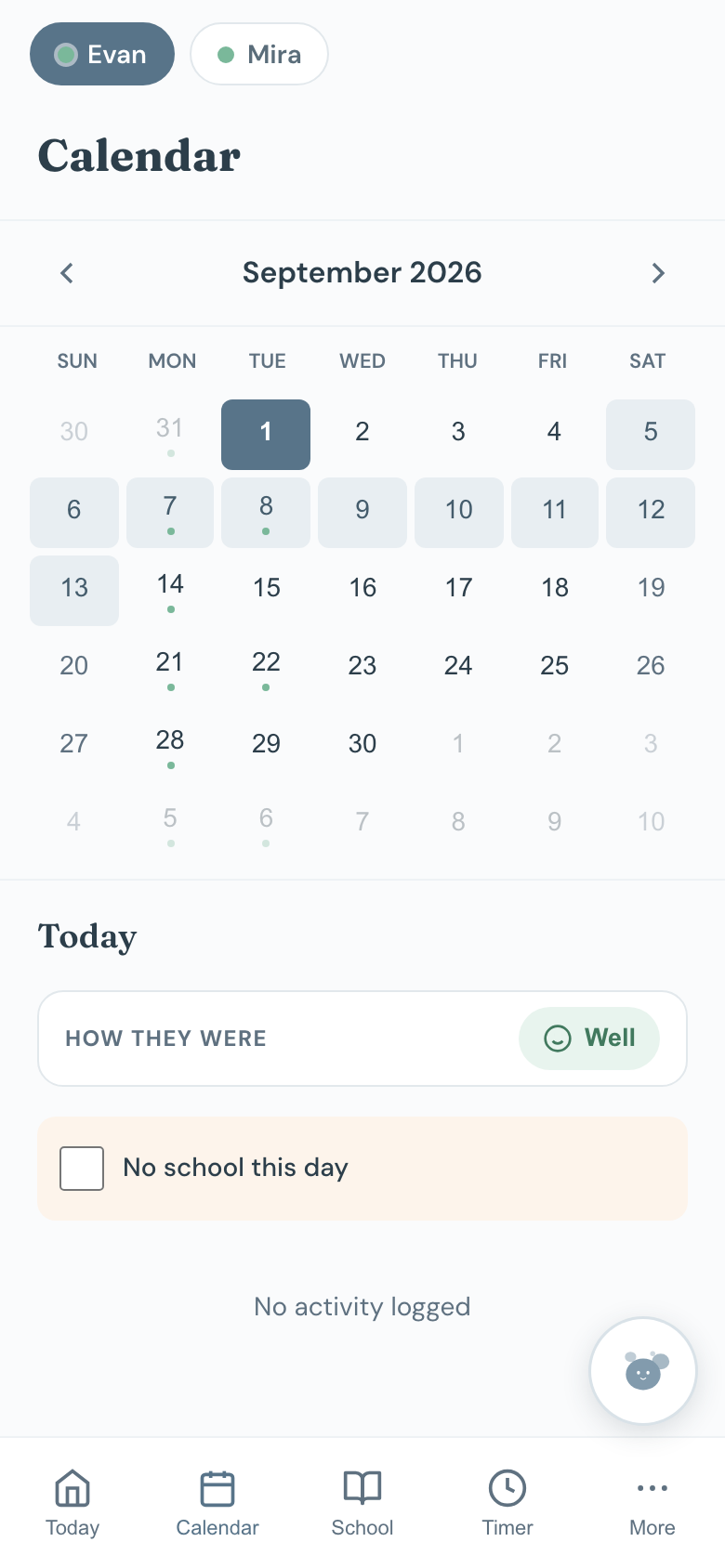
A term break is a date range under School. A single day off is the No school tick on that day in the Calendar.

Either way the day follows the rest-day routine, and the school reminders stay quiet.

Term breaks under School, with a September holiday entered as one range.
The Calendar month view with a single day selected.

Exams

Papers, reporting times, and what gets you before each one.

Turning exams on#

Settings › Children › tick Exams for that child. It is off until you do, so a family with a toddler never sees it.

Exams is its own tab, separate from School: a paper is not homework, and mixing them made both harder to read.

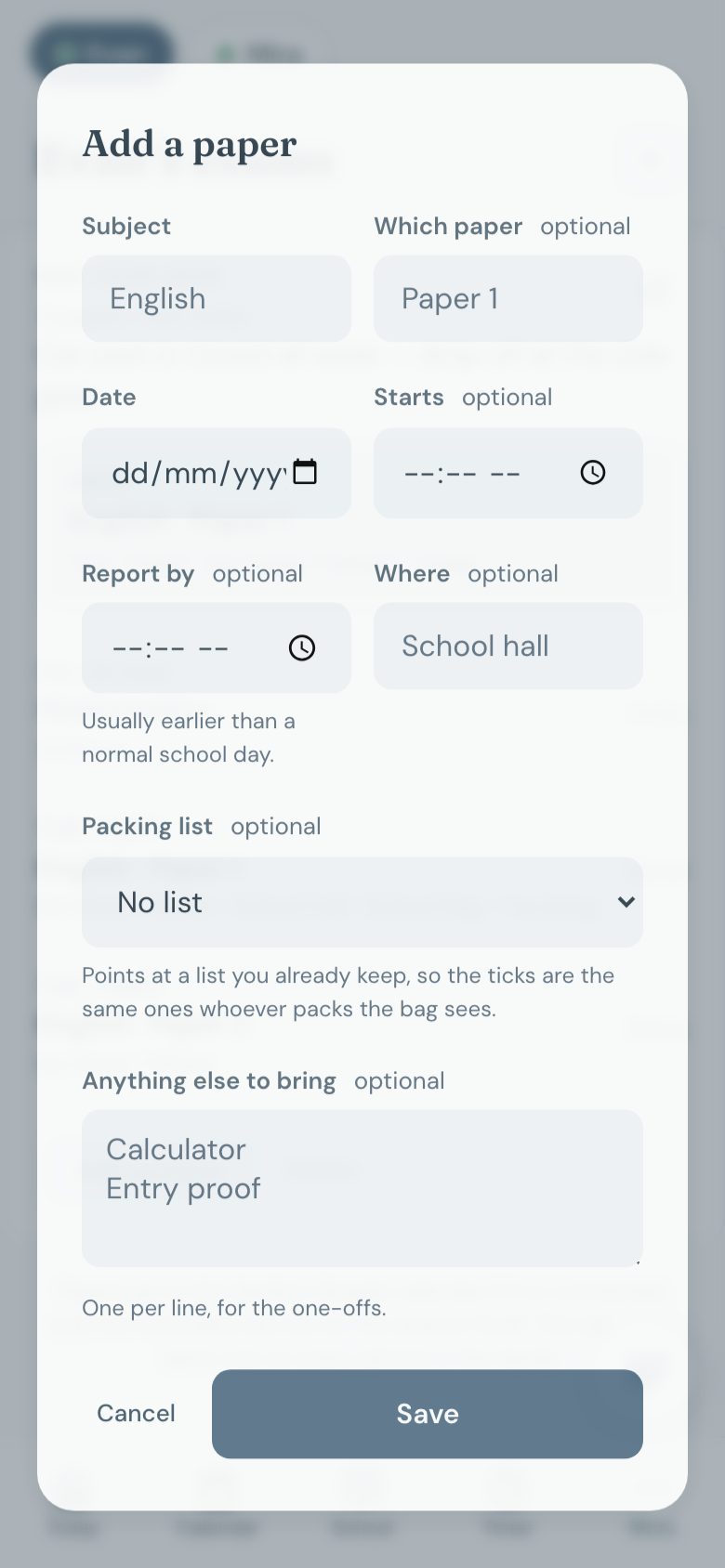
Adding a paper#

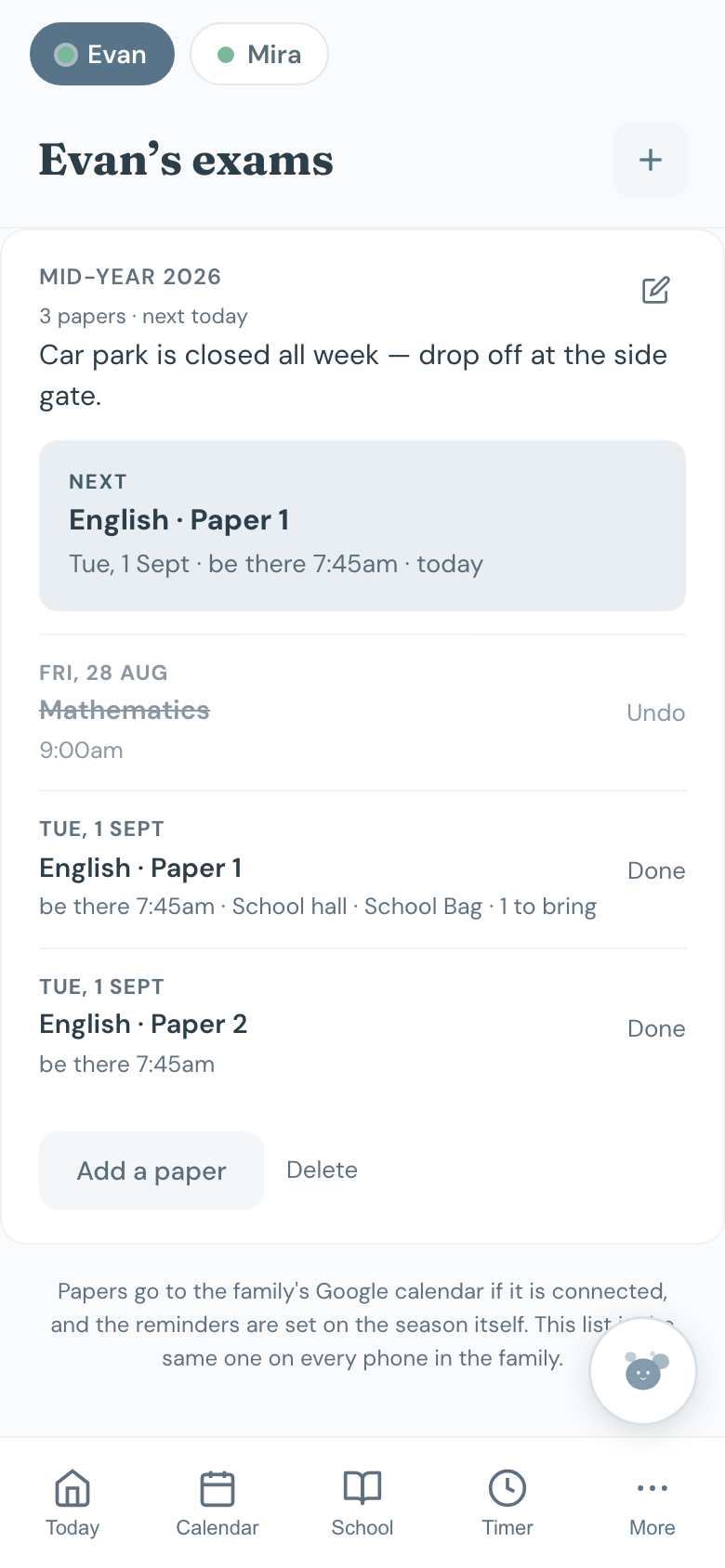
Add a season first — "Mid-Year 2026", "PSLE" — then a paper for each sitting: subject, date, and the reporting time if the school gave one.

You can attach a list of what to bring and any notes, so it is in the app rather than on the fridge.

The Exams tab showing a season and its papers.

What Chico tells you, and when#

Four reminders, each switchable: when revision should start, a week ahead, the night before, and on the morning. You set the night-before time and how long before the reporting time you want the morning one.

These are notifications — please make sure notifications are switched on for Chico.

Meals

Recipes, what each child can eat, and planning a week.

Recipes#

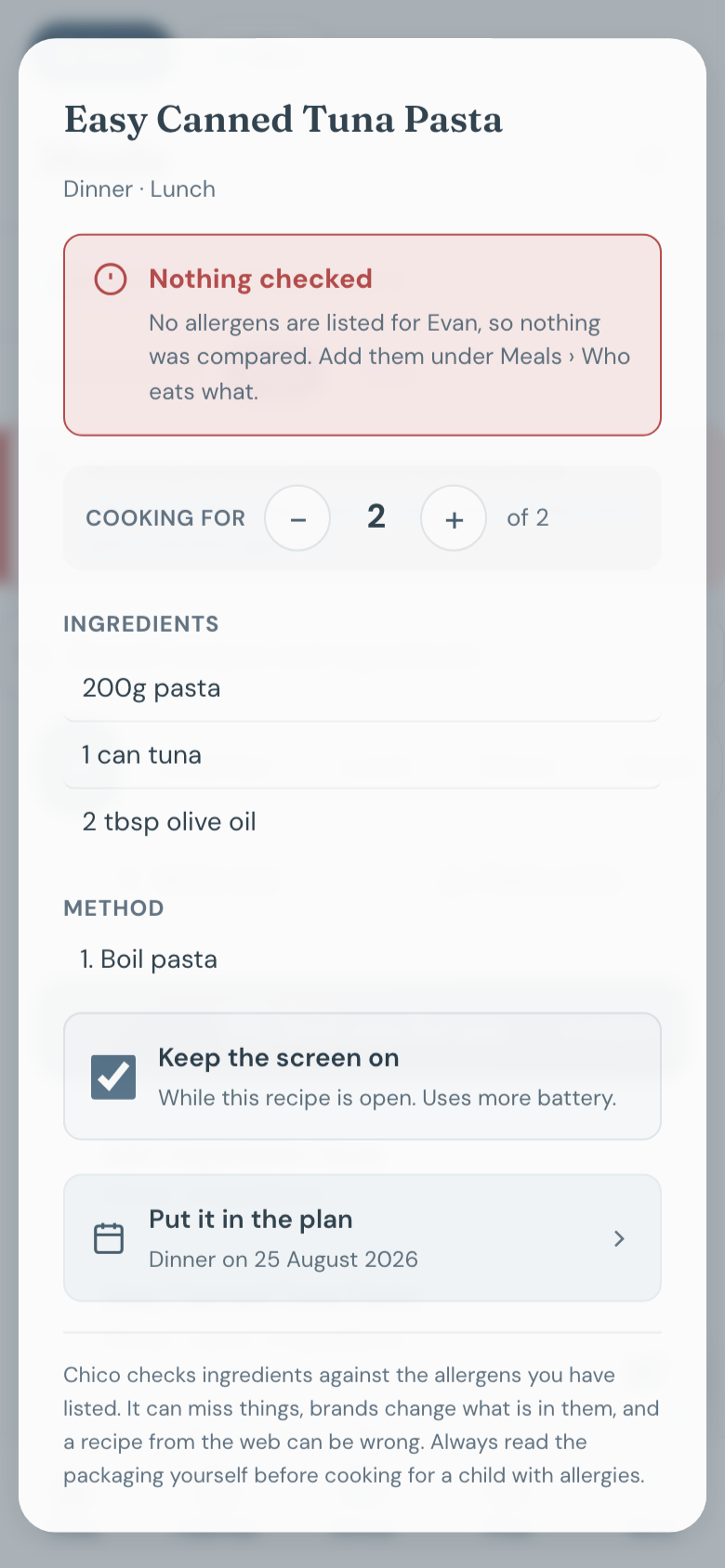
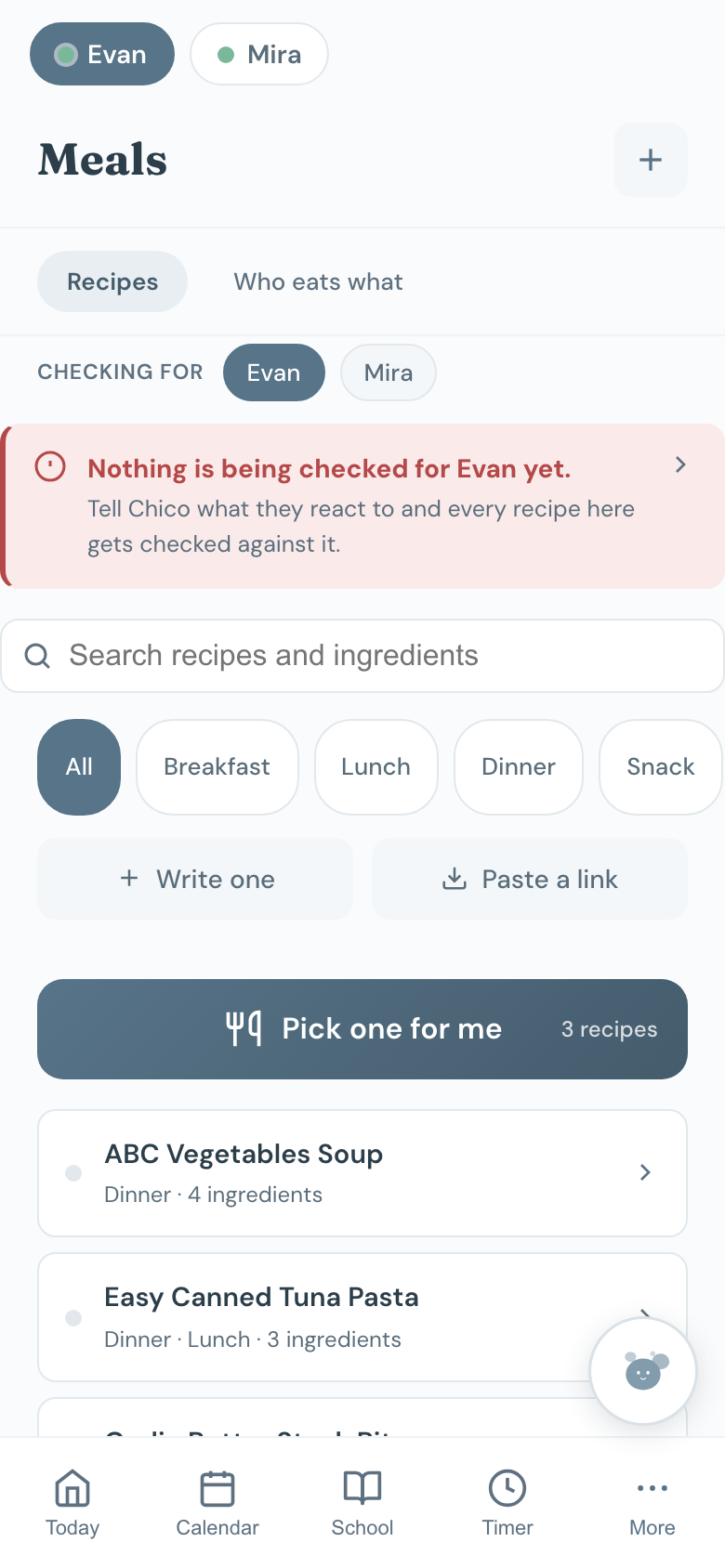
Add a recipe with its ingredients and how long it takes. Chico checks every one against what each child reacts to and tells you which child it is not safe for.

The check only knows what is ticked under Who eats what. Anything typed on the emergency card that is not ticked there is not being checked.

The Meals tab with recipes and prep times.

Who eats what#

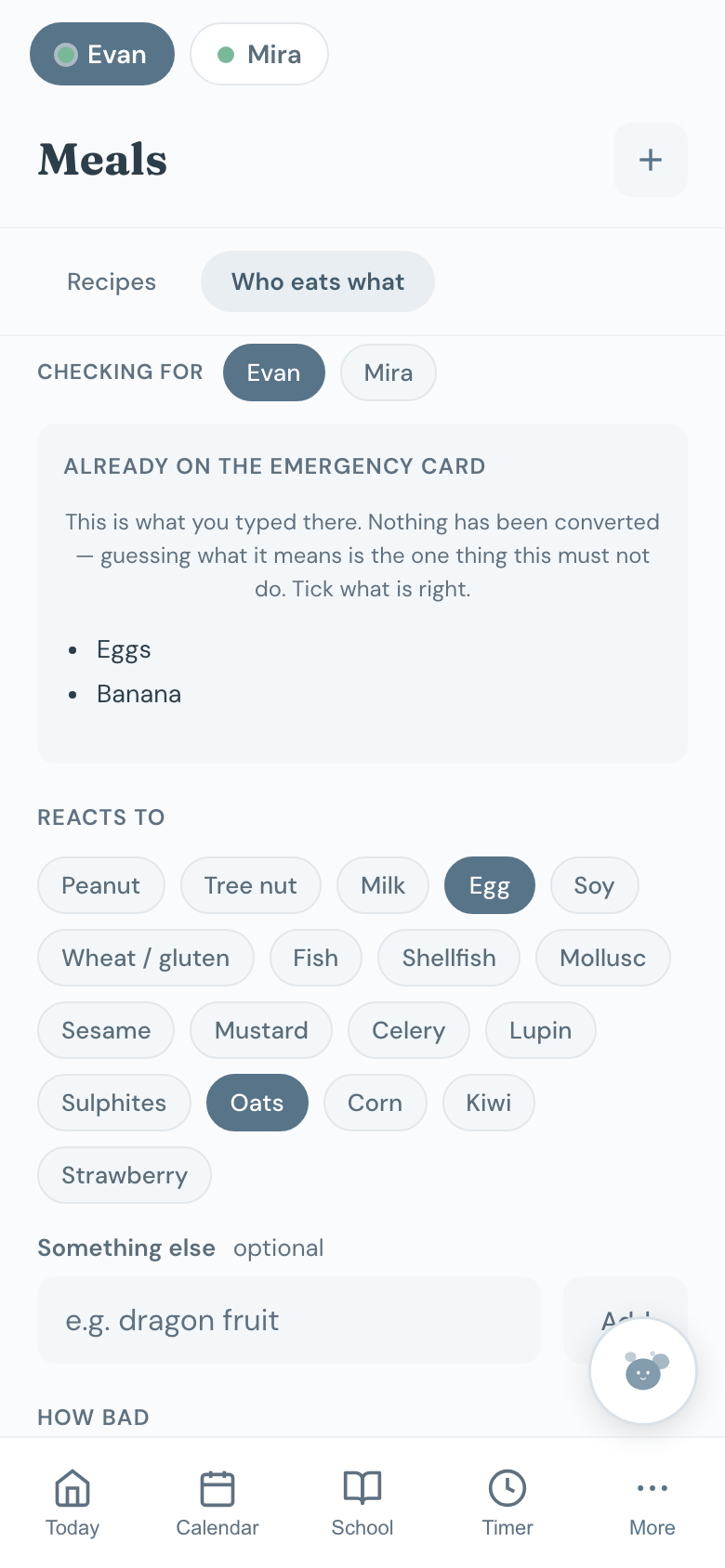
Meals › Who eats what holds each child’s allergens, how severe each one is, and anything they avoid for other reasons.

If you typed allergies on the emergency card, they are shown here for you to confirm so Chico can check recipes for allergens.

The allergen picker with severities and the emergency card list above it.

Planning a meal on a day#

Open a recipe and tap Put it in the plan. Pick the day and which meal it is.

It shows on that day in the Calendar, and on the matching row of that day’s routine. Planning it does not log it — tick it off with Fed when they have actually eaten.

Health

Doses, vitamins, temperature, and what happened last time.

Medicines and doses#

Add a medicine with the dose off its packaging. Chico works out the next safe one from the child’s weight and tells you when it is due — and always asks you to check it against the box.

Every dose is logged with the time, so anyone looking after them can see the last one without asking.

The Health tab with medicines and the last dose recorded.

Vitamins#

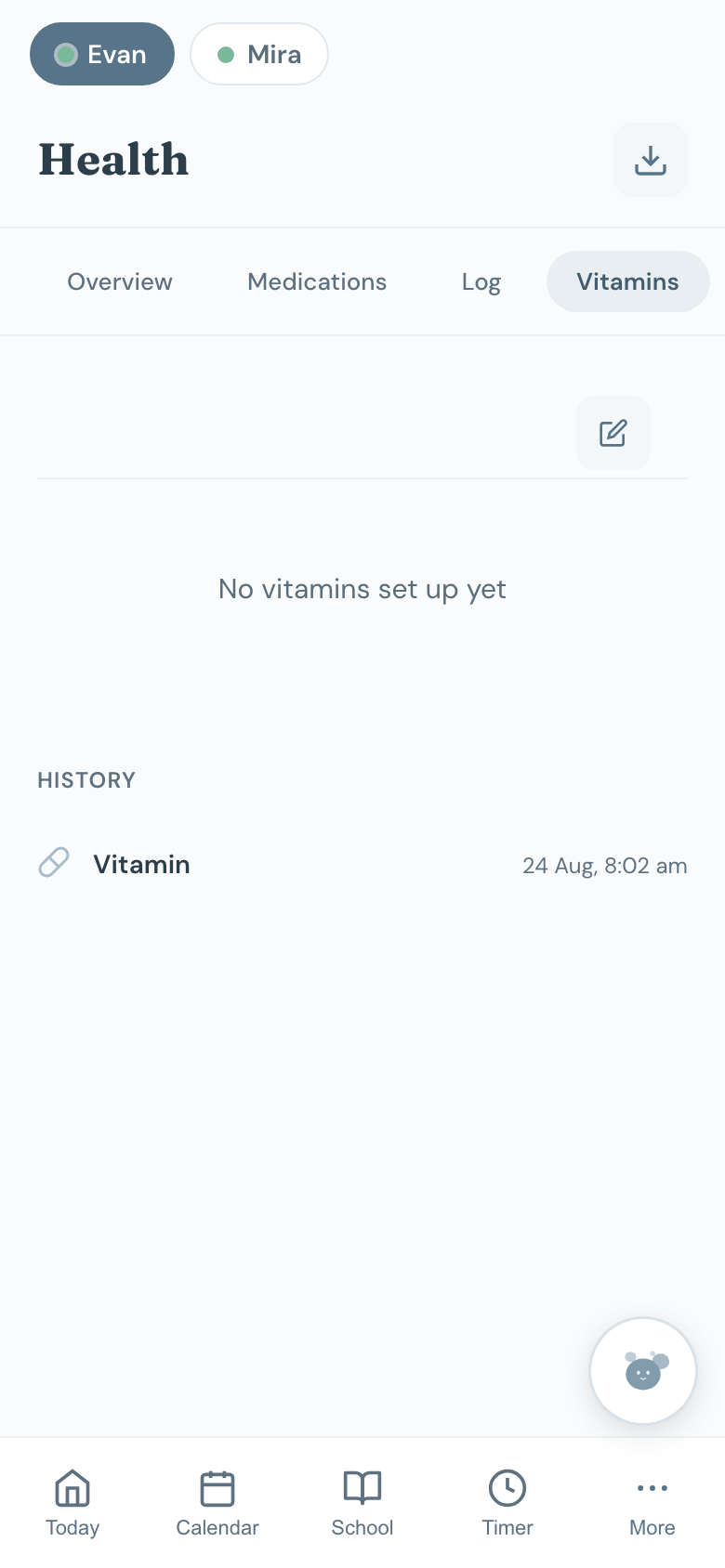
Vitamins are a tab under Health, alongside the medicines — “has she had her vitamins” and “when was the last dose” are the same question about the same child, so they are in the same place.

Daily vitamins get their own row and a reminder at the time you choose. You can log one straight from the notification without opening the app, and there is a strip on Today so you can see at a glance whether they have been given.

The Vitamins tab under Health, with the daily list.

Temperature and symptoms#

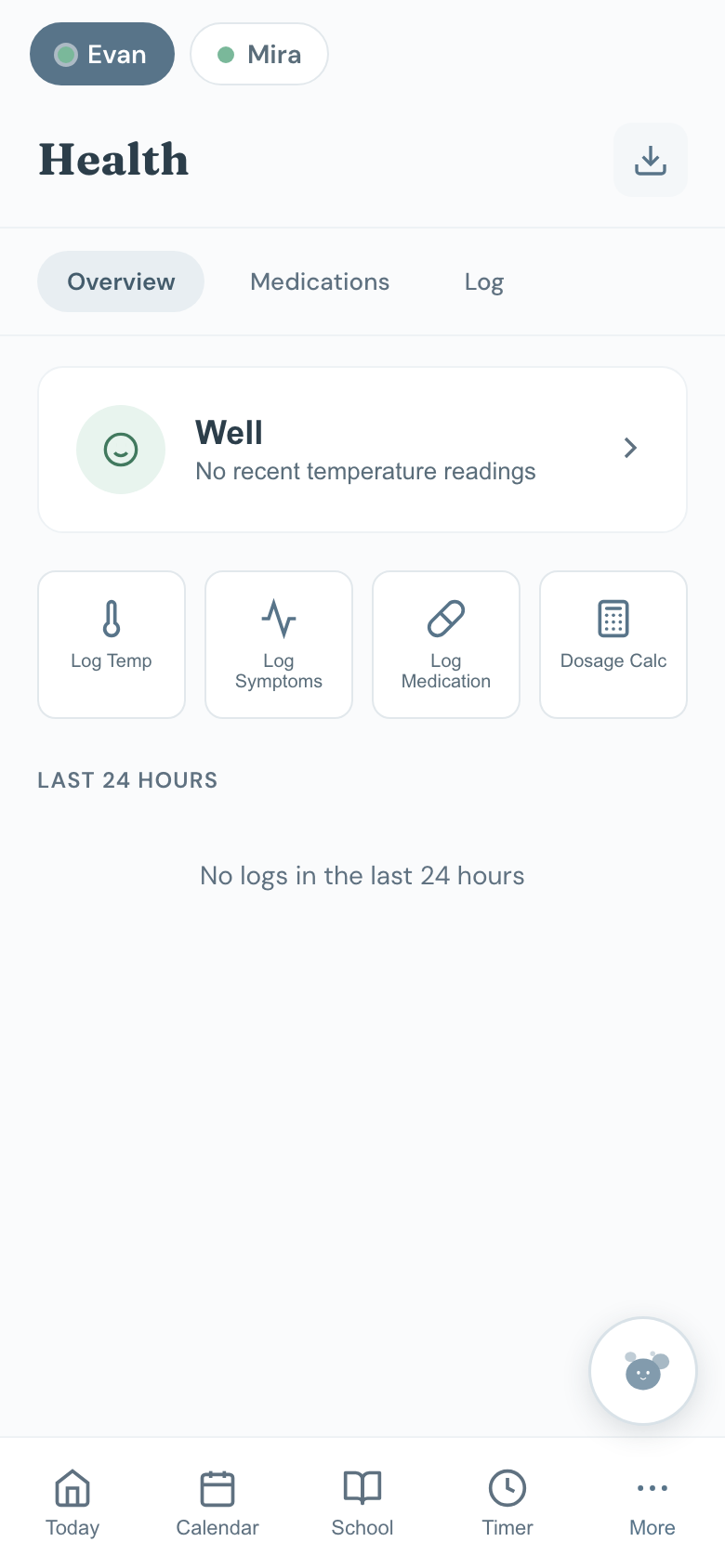
Log a temperature or symptoms from the quick-log buttons when someone is unwell. Chico keeps the run of them so you can see whether a fever is climbing or settling, and so the doctor gets the real answer rather than your best guess.

The emergency card#

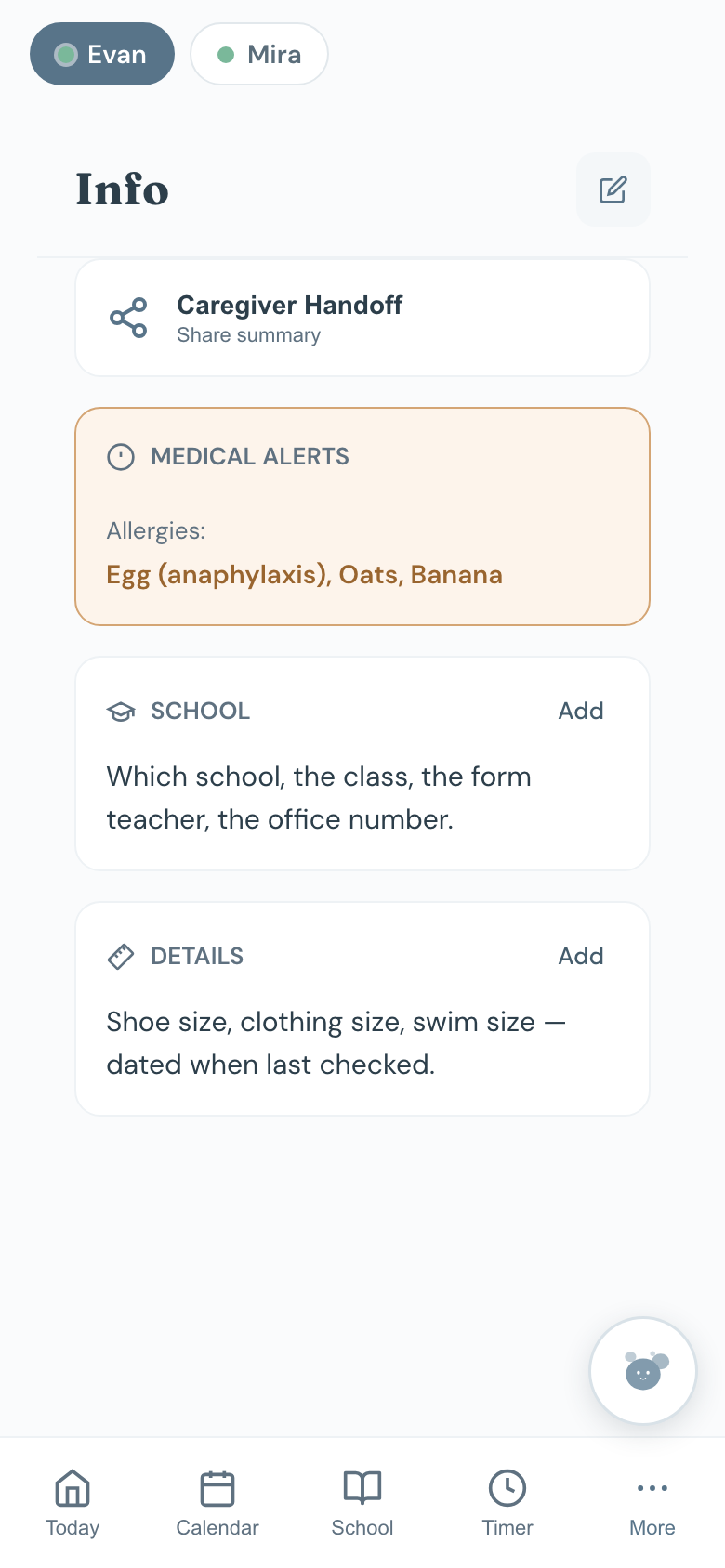
Info holds what somebody else would need in a hurry: allergies, conditions, your numbers, the doctor, the address.

Allergies show here whether you typed them on this card or ticked them under Meals — both lists appear, so a card is never blank because you filled the other one in.

The handoff button turns the whole thing into text you can send to whoever is taking over.

The emergency card with medical alerts and contacts.

Patterns#

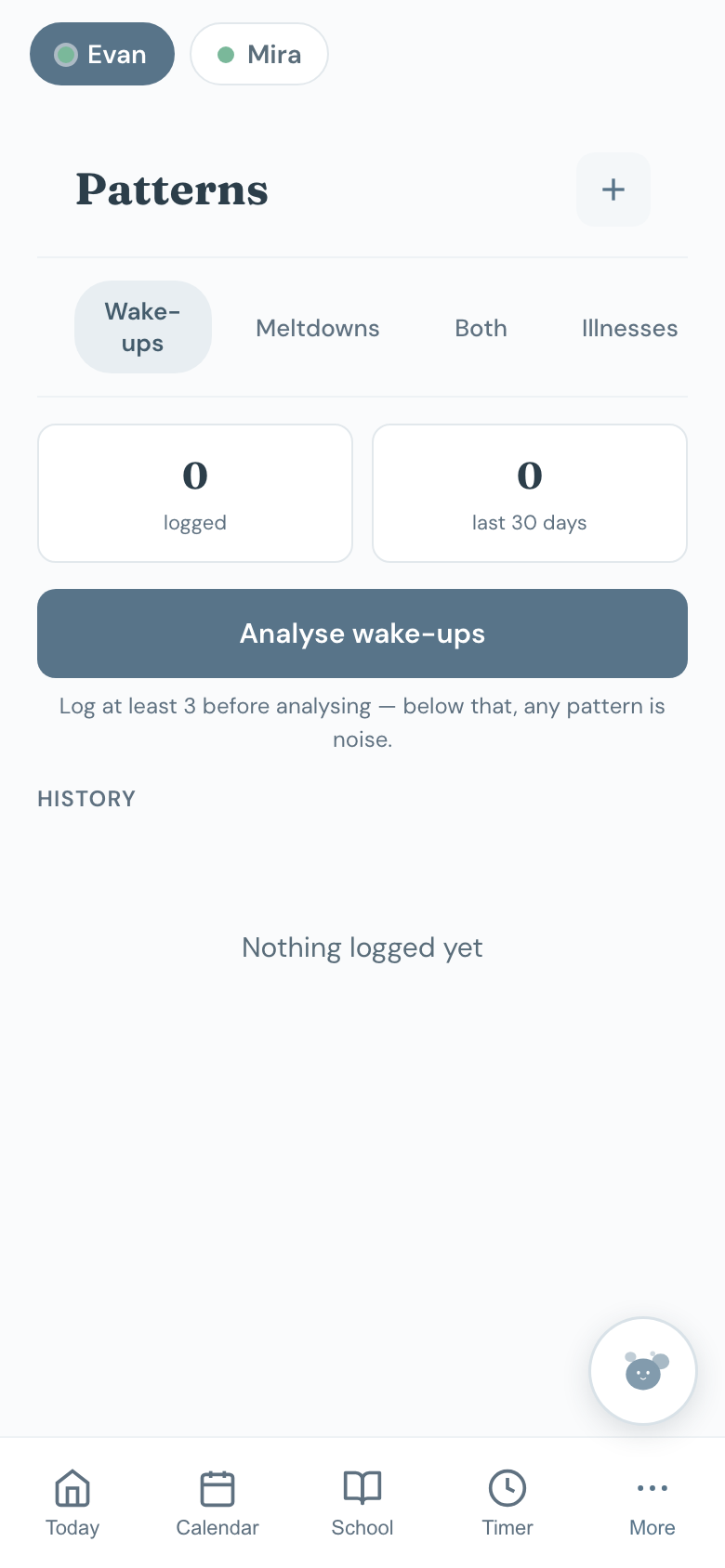
Patterns reads back what has actually been logged: night wakings, meltdowns, and the weeks around each illness — sleep, appetite and the real weather on those days.

It describes; it never diagnoses. And it is for parents only — a helper does not see it.

Patterns showing wake-ups and what they had in common.

Lists

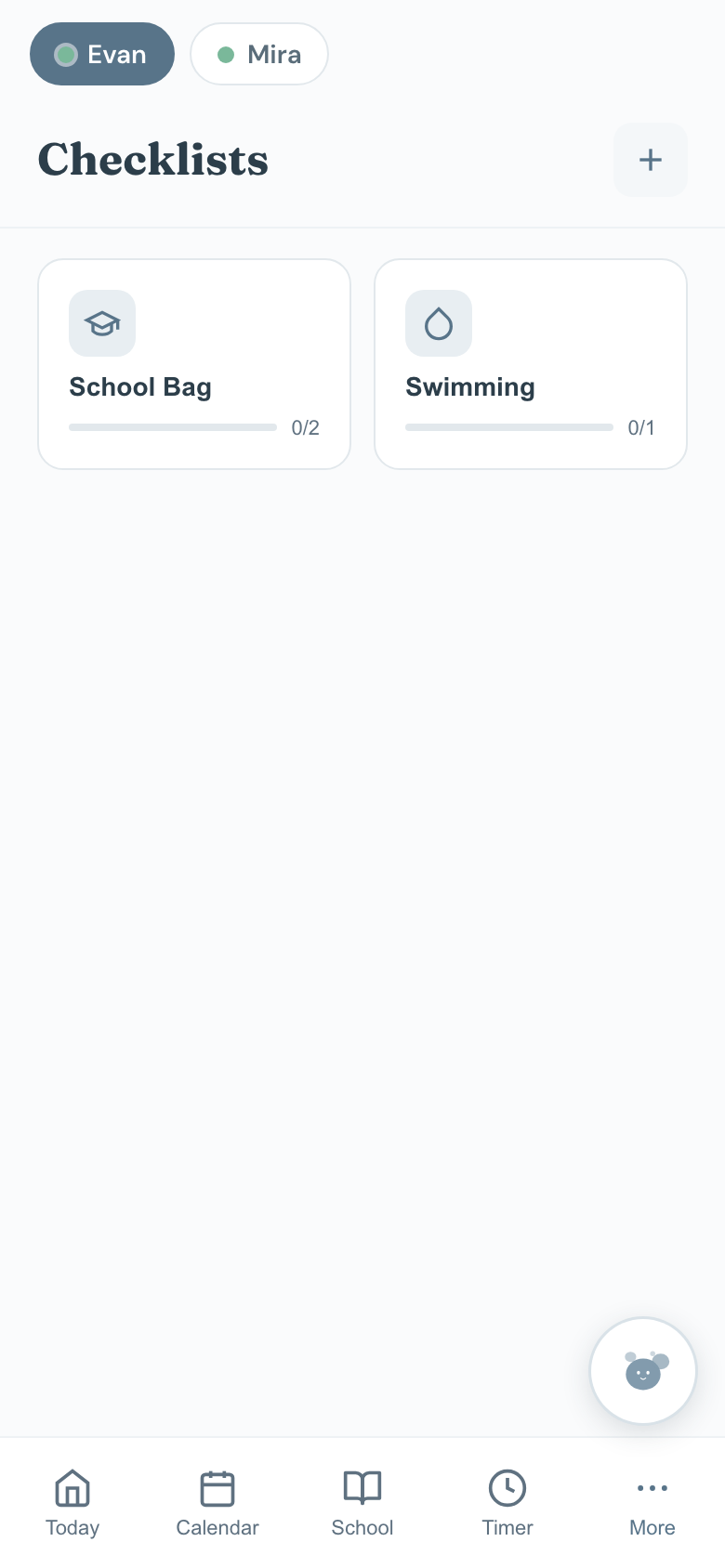
Packing lists, bags, and anything with things to tick off.

Making a list#

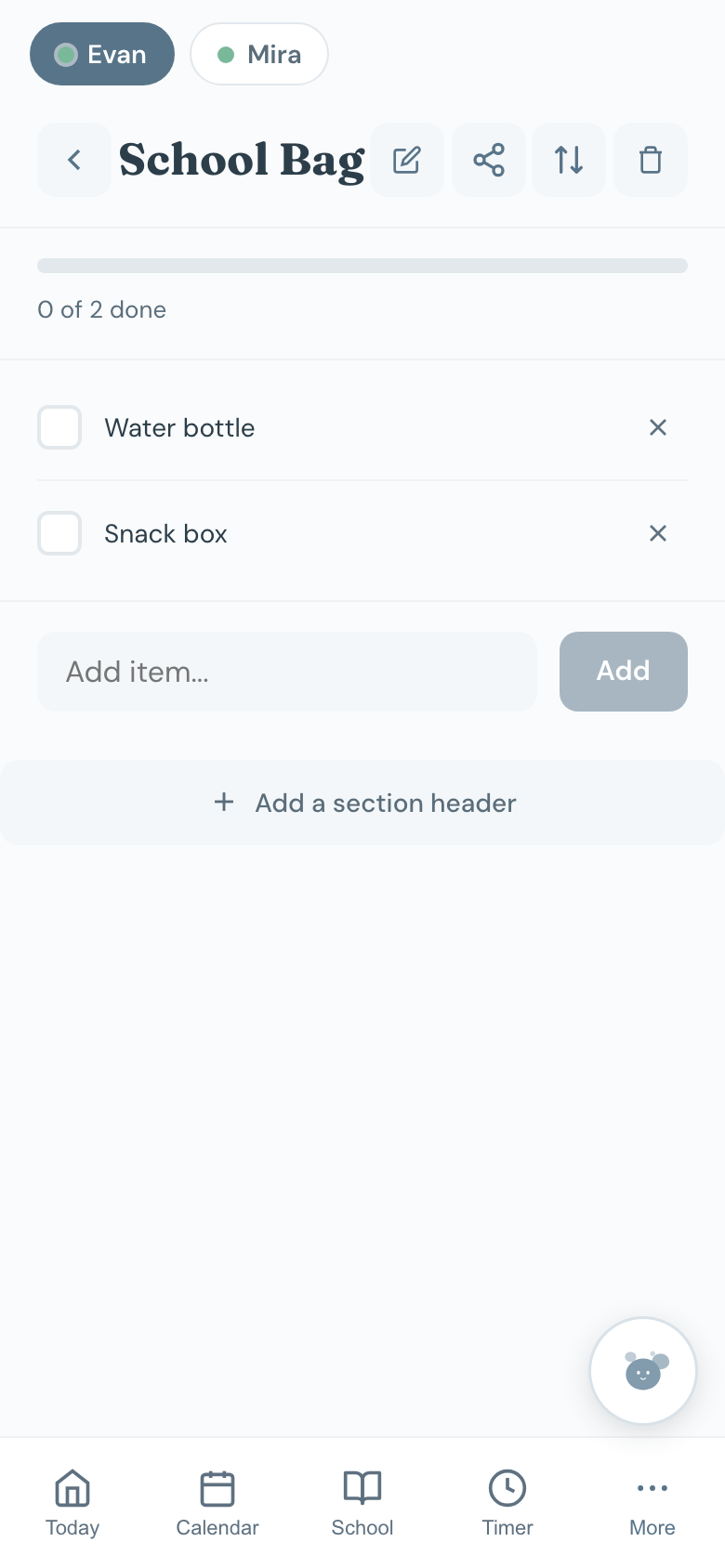
Lists › add one, then add rows. Use Add a section to group a long list — Clothes, Medicines, Documents — and dragging a section takes everything under it.

Tap any row to retype it. Tap the reorder button to get the handles, then drag.

A list with sections and items to tick off.

Sending a list to someone#

The copy button turns the list into text you can paste into a message, sections and all, with the ticked things marked. Useful for handing a packing list to whoever is doing the packing.

Getting Chico AI to write one#

Paste an old list into Chico AI and ask it to adapt it — for a shorter trip, a different season, an older child. It writes a new list and leaves the one you pasted from alone.

To add to a list you already have, just say so: "add sunscreen to the Bali list". It only adds; nothing already on the list changes or loses its tick.

Play and TV

Ideas when you have run out, and what they are allowed to watch.

The activity library and the spinner#

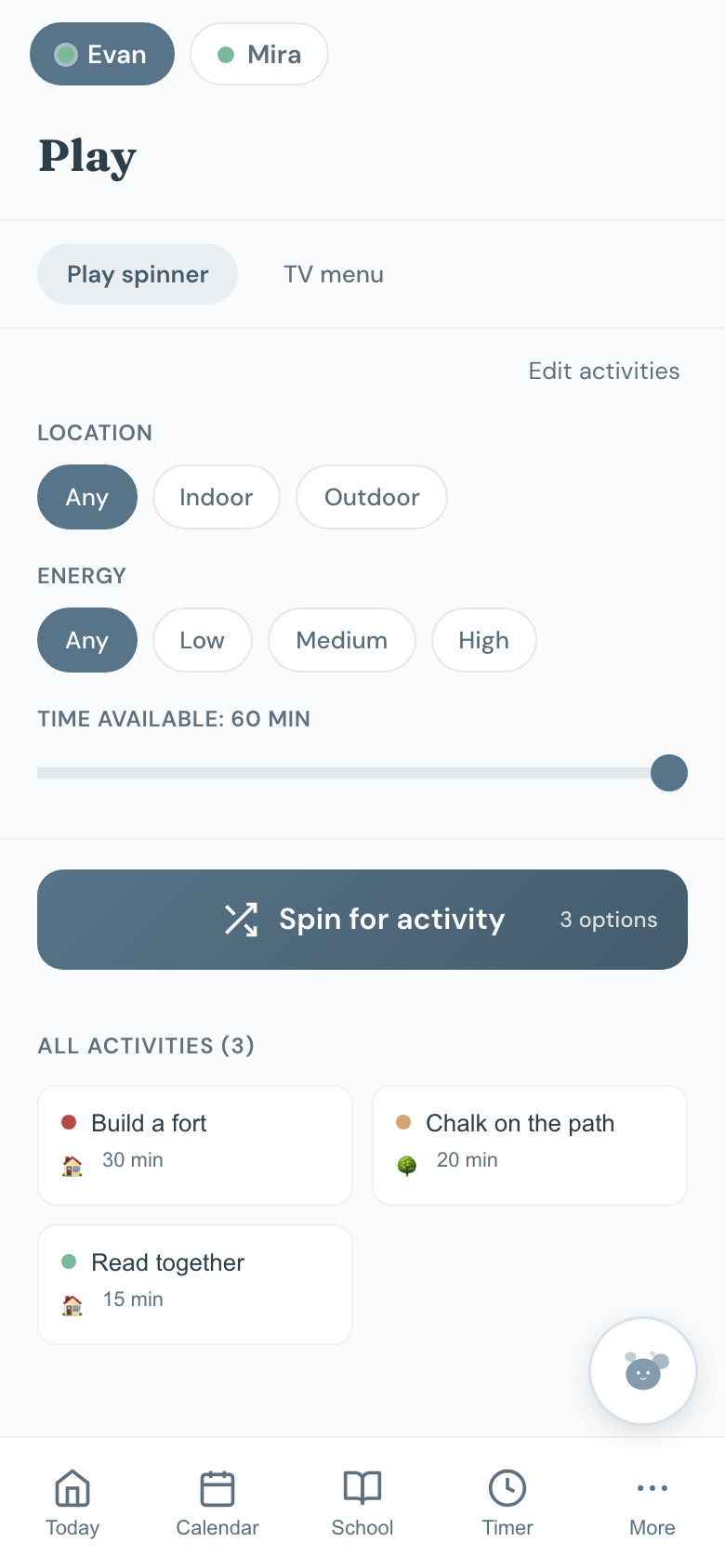
Add the things you actually do, tagged indoor or outdoor, quiet or loud, and how long they take. When you are out of ideas, filter and spin.

A Play row in the routine offers Spin the wheel in its reminder, once there is something in the library to spin.

The Play tab with activity cards and the spinner.

The TV menu#

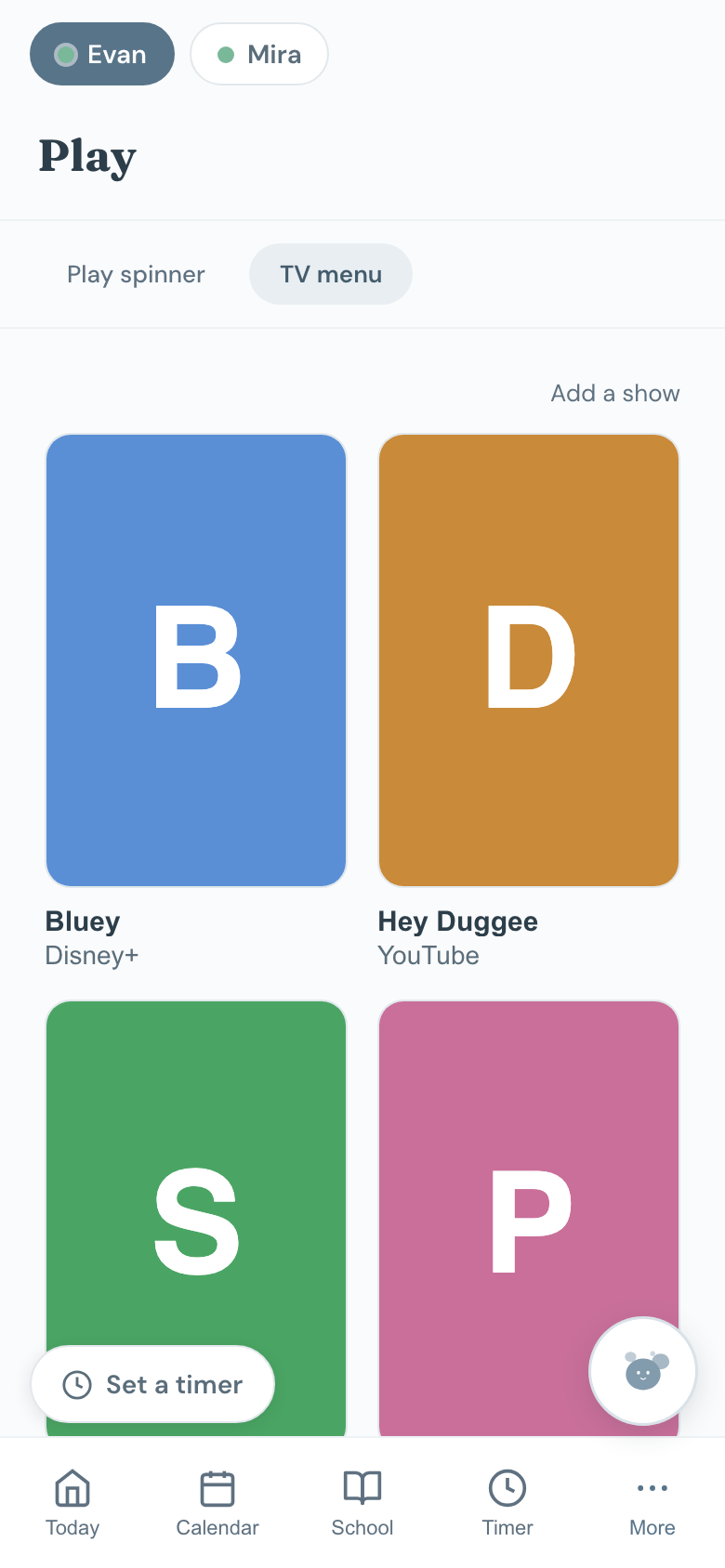
A short list of what they are allowed to watch, with the channel and a picture. It is there so a helper does not have to guess, and so the answer to "can I watch this" is on the screen rather than in an argument.

A Screen row in the routine offers TV menu in its reminder, once there is a menu to open.

The TV menu with approved shows.

Timer

A clock a child can read without knowing numbers.

The visual timer#

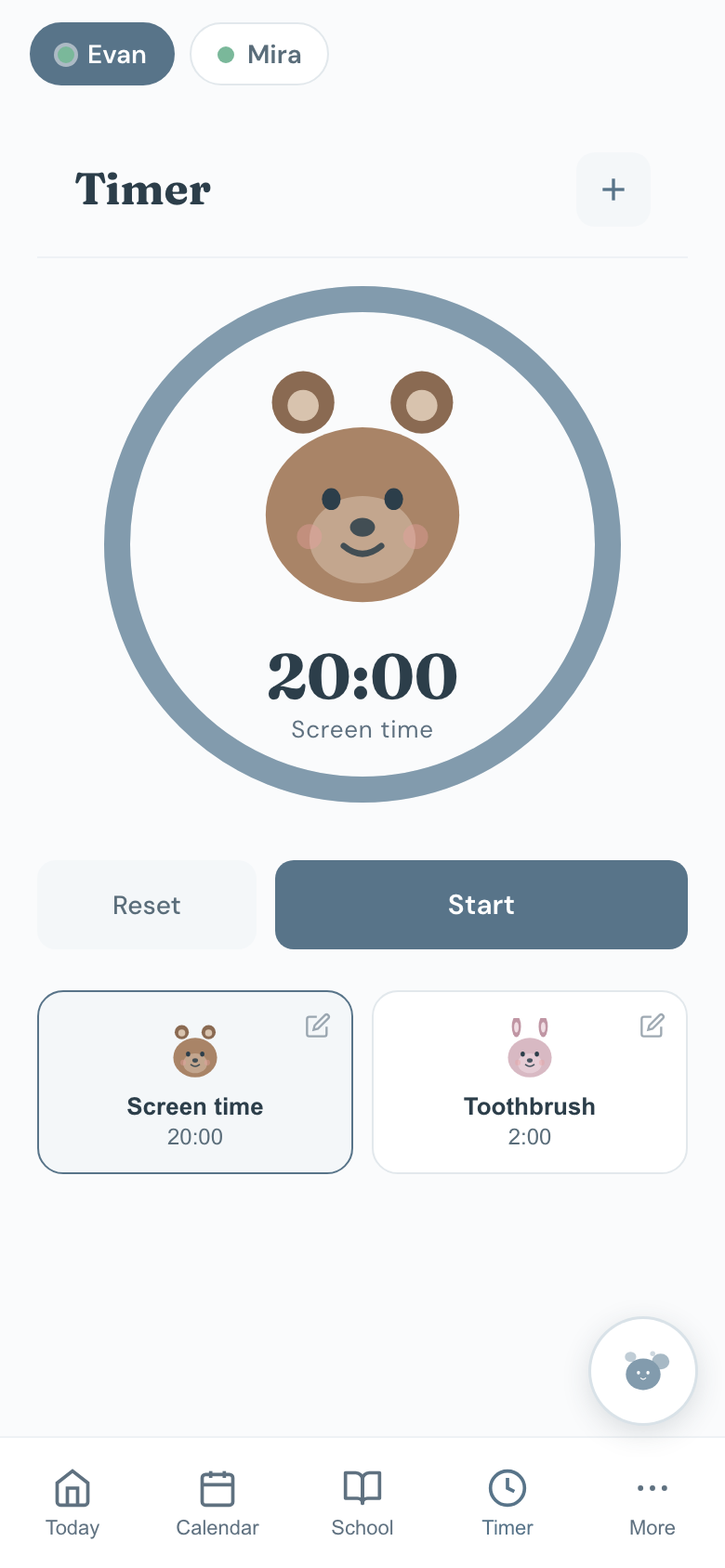
A ring that empties as the time goes, so "five more minutes" is something they can see rather than something they have to trust.

Save the ones you use — screen time, tooth brushing, the walk to the car — and pick a sound for the end, or none.

The visual timer counting down with saved presets.

Chico AI

The assistant inside the app: what it can see, and what it will do.

What you can ask it#

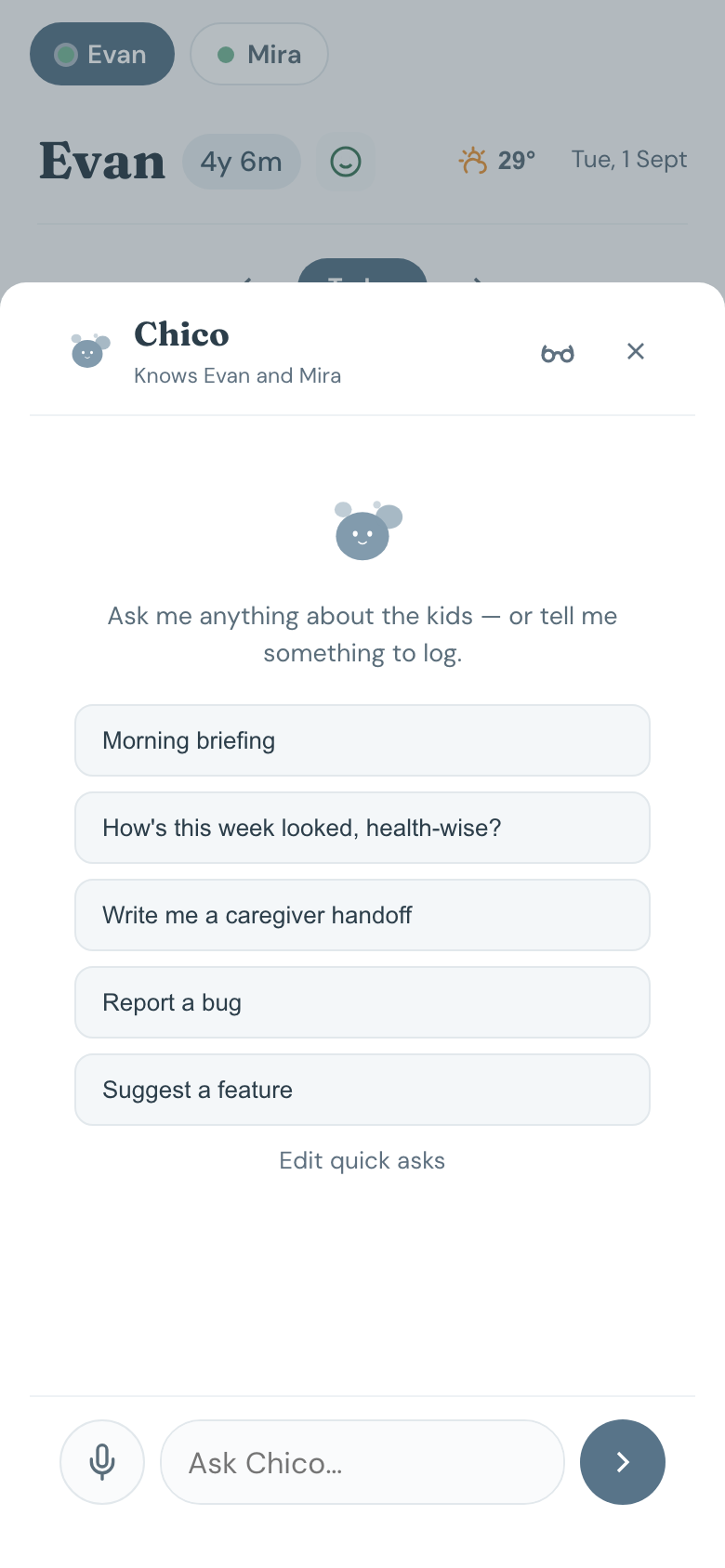
Tap the Chico AI button on any screen. It can see this family — every child, the last two weeks of logs, routines, medicines, school items, lists, recipes — and answers from that.

Ask it what happened ("when did she last have Panadol?"), or tell it something to record ("Evan had 5ml of Panadol at 2pm").

A conversation with Chico AI showing a proposed change to confirm.

It never writes without asking#

Chico AI proposes; you confirm. Anything it wants to record shows as a card with a Confirm button, and nothing reaches your data until you tap it.

A helper can confirm the same things a helper could do by hand — logging what happened, adding to a list. Changing a routine, a medicine or a setting stays with a parent.

Talking to it#

Tap the microphone and say it out loud. It transcribes as you speak and you can edit before sending.

The microphone hides itself for a language with no voice model, rather than transcribing into nonsense.

Sharing and helpers

Getting everyone on the same page, and what each of them can change.

The two codes#

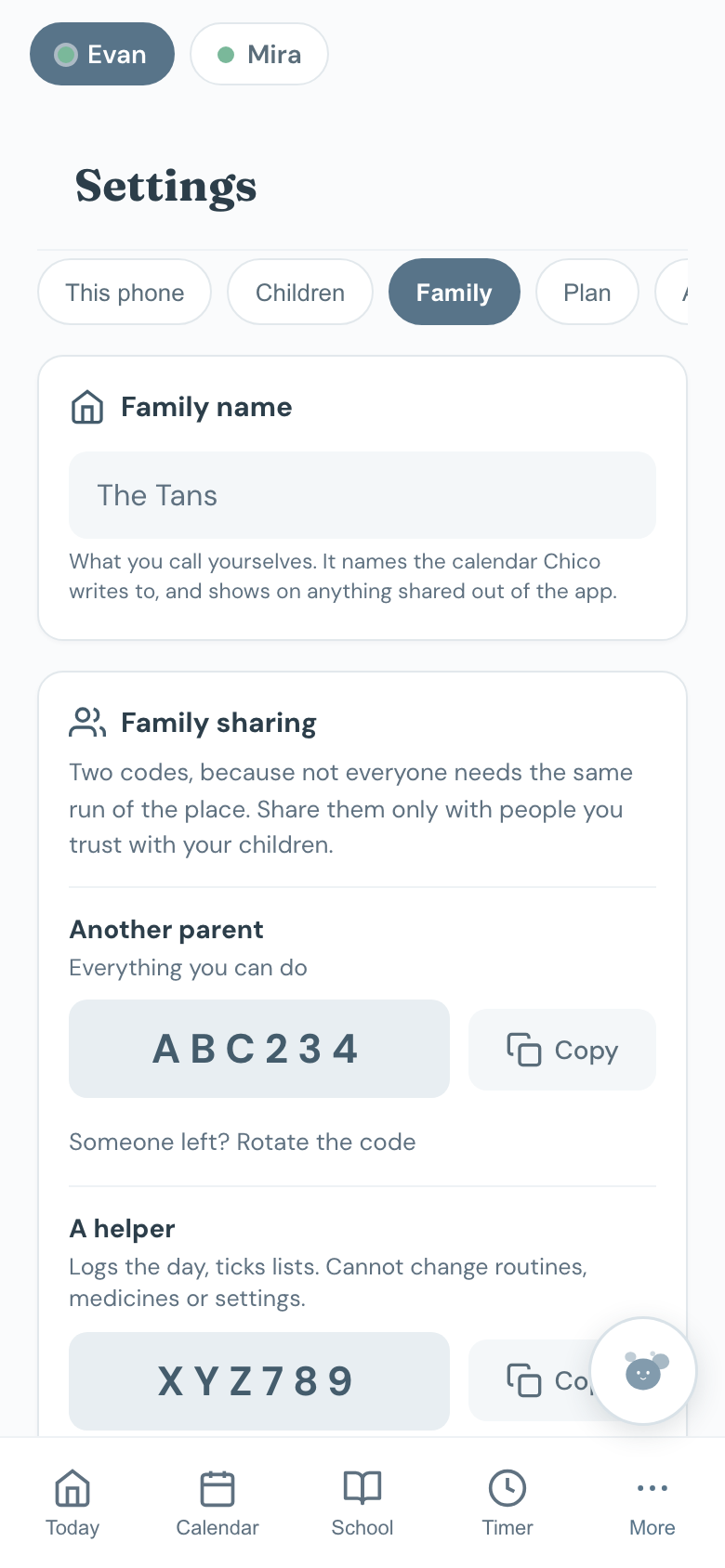
Settings › Family has two codes, and which one you send decides what that person can do.

The parent code gives full access — use it for the other parent. The helper code gives the limited access below — use it for a grandparent, a helper, a nanny.

The Family section of Settings showing the invite codes and members.

How someone joins#

Send them the code. They install Chico, sign in with their own Google account, and enter it when asked whether they are starting a family or joining one.

They are in the same family from that moment — nothing to accept on your end.

What a helper can and cannot do#

A helper sees the whole day and can record what happens. What they cannot do is change how the family is set up.

A helper can

  • See Today, the routine and the calendar
  • Log feeds, nappies, naps, baths, temperature and medicine given
  • Edit or delete a log they wrote themselves
  • Tick things off a list, and add to one
  • Use Chico AI to ask questions and to log what happened

A helper cannot

  • Change the routine
  • Add or edit medicines, vitamins or the emergency card
  • Add or remove children, or change settings and the plan
  • See Patterns
  • Invite anyone or remove anyone
  • Edit or delete a log somebody else wrote

Removing someone after they leave#

Two things, and do both.

Settings › Family › find them in the members list › Remove. They lose access immediately.

Then tap New code on the helper code. The old code stops working the moment the new one appears, so anyone still holding it cannot rejoin. Send the new one to whoever should still have it.

Reminders

Getting told at the time, rather than remembering.

Turning them on#

There are two parts, and both have to be true before a single reminder arrives: this phone has to allow notifications, and the child has to have reminders switched on.

The quickest way is the Yes, remind me card — one tap does both, for every child, and switches on the two most families want.

Otherwise: Settings › Children › Reminders. Each phone that signs in needs its own permission.

The card on Today asking whether Chico should send reminders.

What each one does#

Six kinds, each switchable per child: medicine when the next dose is due, the next step in the routine, a nudge to start prepping a meal, a diaper check on an interval, a bathroom check, and a feed reminder based on when the last one was logged.

They go to every caregiver signed in on their own phone, not only yours.

Quiet hours#

Nothing arrives between 10pm and 6am unless you change it, under Settings › Children › Reminders.

If you are on an iPhone#

iPhones will not deliver notifications to a website. Chico has to be on your Home Screen first, and then opened from that icon rather than from Safari.

Once it is, Chico will ask about turning reminders on.

The same card on an iPhone, explaining that the Home Screen has to come first.

Languages

For a household where not everyone reads the same one.

Which languages Chico AI speaks#

Chico AI replies in English, Simplified Chinese, Bahasa Melayu, Tamil, Bahasa Indonesia, Burmese or Cantonese — or it matches whatever the phone is set to.

You can talk to it out loud in all of them except Burmese, where no browser has a voice model yet. There the microphone is hidden rather than transcribing nonsense.

The language picker under Settings, each language in its own script.

Where the setting applies#

It changes the language Chico AI replies in, on this phone only. The app’s own labels stay in English.

It belongs to the phone rather than the account, so a grandmother reading Chinese and a parent reading English can share one family and each get their own.

Your data

What Chico holds, and how to take it or delete it.

Downloading everything#

Settings › Account › Download my data. Everything Chico holds for this family comes out as a JSON file.

The Settings screen with its sections.

Deleting your account#

Settings › Account › Delete my account. It closes your account and takes you out of the family.

The family and its records stay, because they belong to everyone in it. If you are the last person, tell me and I will remove the family too.

Shopping for the week#

Meals › Shopping takes the meals you have planned and works out what you actually need to buy. The slider picks how far ahead: today only, or the next 3, 5 or 7 days.

Ingredients are added up rather than repeated. If Bolognese wants a cup of pasta and Carbonara wants a cup, that is one line saying 2 cups, with both meals named underneath so you can see where it came from. A whole onion in one recipe and a quarter in another comes to 1¼ onions.

Everything starts as Need to buy. Walk the list tapping In stock on the things you already have — that way a row you never got to is still on the list at the end, which is the mistake worth avoiding.

Then Copy list to paste it into a message, or Make a list to put it in Lists as “Grocery shopping for” today, with the aisles as headings, so you can tick it off in the shop.

Ingredients are sorted into aisles. Anything Chico does not recognise goes to Other at the end rather than being guessed into an aisle — a wrong aisle sends you to the far end of the shop for nothing. Two spellings of the same thing are treated as one, but “onion” and “yellow onion” stay separate, because a red onion is not a spring onion and merging them would be worse than listing both.

Google Calendar#

Settings › Family › connect Google Calendar and Chico puts school items, activities, exams and meal plans into a calendar of its own, named for your family, alongside the ones you already have. Each child gets their own colour and their name on each entry.

It goes one way. Chico writes into that calendar; it does not read yours.

Two switches sit under the connection. Dated things — school, activities, exams, meal plans — is on to start with. Routines is off, because it fills a calendar: every row of every day, repeating week after week.

Switch routines on and each day’s routine goes in as a weekly repeat in the child’s colour. Monday to Friday on the same routine becomes one entry across five days, not five. They are marked free rather than busy, so they do not make you look booked all day, and Google’s own alerts are off on them so you are not told twice.

Holidays, term breaks and days you have ticked as no school follow the rest-day routine in Google, the same as they do in Chico.

Sick days go in as well, one day at a time. Mark a child unwell and today swaps to the rest-day routine in Google too. Tomorrow is left as an ordinary school day, because you do not know yet — if they are still unwell in the morning Chico moves that day over as well, at 4am, and keeps doing it until you mark them well. Mark them well and the day goes straight back to normal.

Nothing matches that. Try a word that would be on the screen — helper, dose, routine — or ask Chico in the app.