
You pull the curtain back and the view from your block is a grey sky, other buildings partially obscured by the haze. And there's that smell that makes your throat scratchy and your eyes water. And your first thought is a logistics one: what happens to today?
Swimming was supposed to be at 10am. Your mother was going to take them to the park after lunch. The helper has the afternoon with both of them and no instructions beyond the usual. Somebody has to decide whether any of that still stands, and that somebody is you.
This is not about whether haze is bad for children. People far better qualified than me have written that, and the National Environment Agency publishes health advisories every time it gets serious. This is about the part nobody writes down: changing a week at short notice, and getting everyone in the house to agree on what kind of day it is.
The real problem is that everyone has a different threshold
Here is what actually happens in a hypothetical house on a hazy day.
As a mom you might look at the PSI and think: today we're staying indoors. Your mother looks out of the window, decides that eh, it doesn't look too bad, and takes your kid down for a walk because fresh air is good for children. Your helper has no view either way and does not want to overstep, so she waits to be told, and if nobody tells her, the morning plan just happens.
Nobody is being careless. The word "unhealthy" just means something different to each of us.
Four things that help on a haze week
Masks they will actually wear. I buy the ones printed with whichever cartoon character my son's obsessed with (Spiderman this week). A three year old who is excited about wearing something will wear it for the ten minutes between the car and the lift. Buy them before you need them, and remember to keep a spare for the bag.
An air purifier, in one room rather than everywhere. Or in more than one room, if you can make that work. One machine trying to clean a whole flat with the doors open doesn't do much. But if you put the same machine in the bedroom and close the door from the afternoon onwards, you'll end up with one room with cleaner air that they can spend 10 hours sleeping in.
Sort out an indoor playground membership this week. Not a last-minute booking on the afternoon you're already desperate and so is everyone else. If the haze is settling in for a stretch, a membership somewhere with soft play is the difference between four manageable afternoons and four afternoons of explaining to a toddler why you can't go to the park.
Check a number. Just know which number you're looking at. The PSI on the news and the reading on your phone aren't measuring the same thing, and on a bad morning they can be a long way apart.
Why the number on the news can look fine on a bad morning
The PSI you see on the news and on the myENV app is a 24 hour reading. That's how NEA does it, but it doesn't tell you what the air will be like right now.
That's fine for the question it answers. It's just not your question, which is: can they go to the park now?
Say the air turned bad this morning. The number is an average of the last 24 hours, and most of those hours were fine. So the number stays low while the air outside your window is actually quite bad for them.
As a parent, I wished I could get a straight answer instead of having to Google and try to work out what the air quality was like, so I built it right into the Chico app's home screen.
Chico works out the AQI (Air Quality Index) from the PM2.5 reading that NEA shows right now, so it's up to date. It won't match the PSI on the news, and the chip always says AQI so nobody mistakes it for one. In Singapore the reading comes from NEA's own measurements.
What we do instead
The air sits on the Today screen next to the temperature, for everyone who opens Chico. Whoever's got them that day sees the same number you do, at the same time.
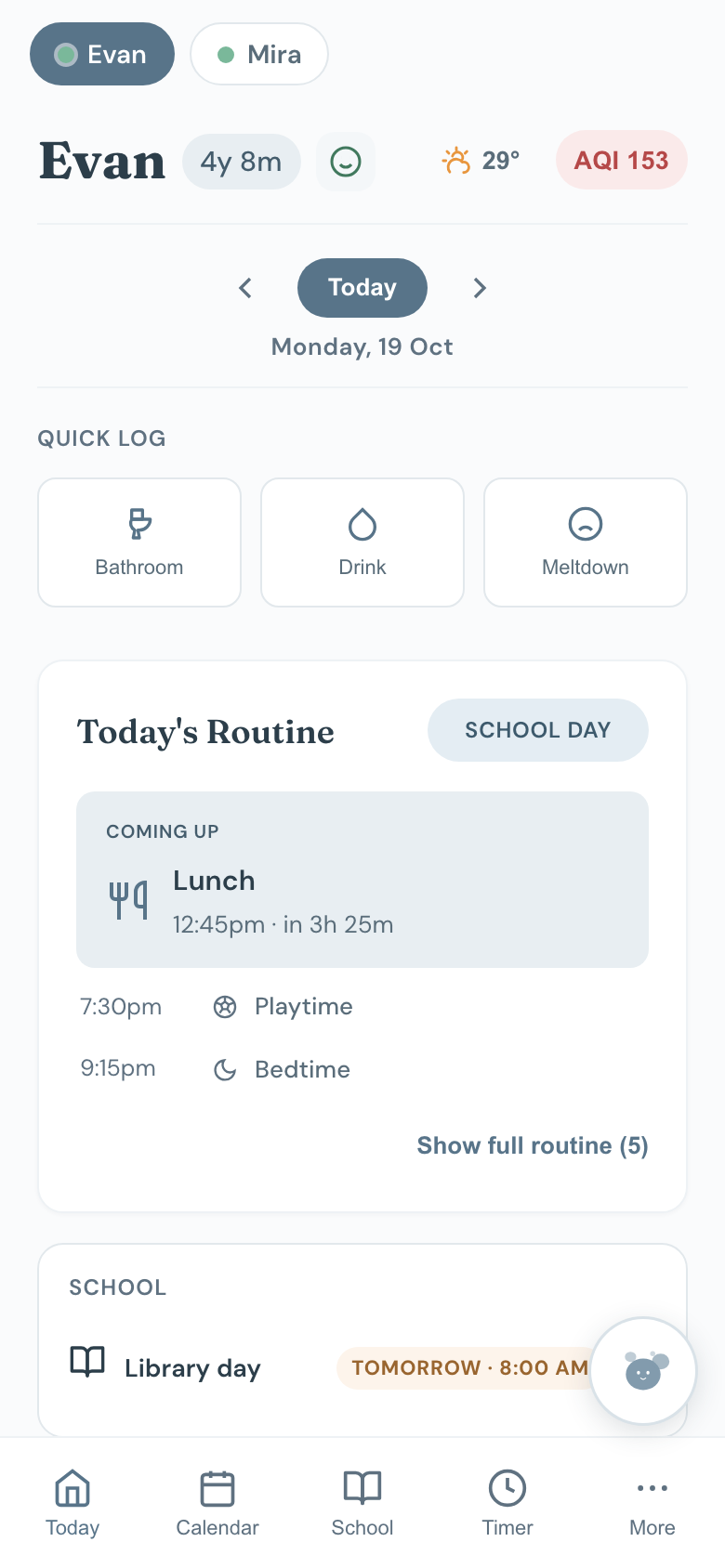
Tapping it turns that number into advice you, your parents or your helper can act on. In plain terms, it tells you whether you can go out but keep the outdoor time short, or whether you shouldn't go out at all.
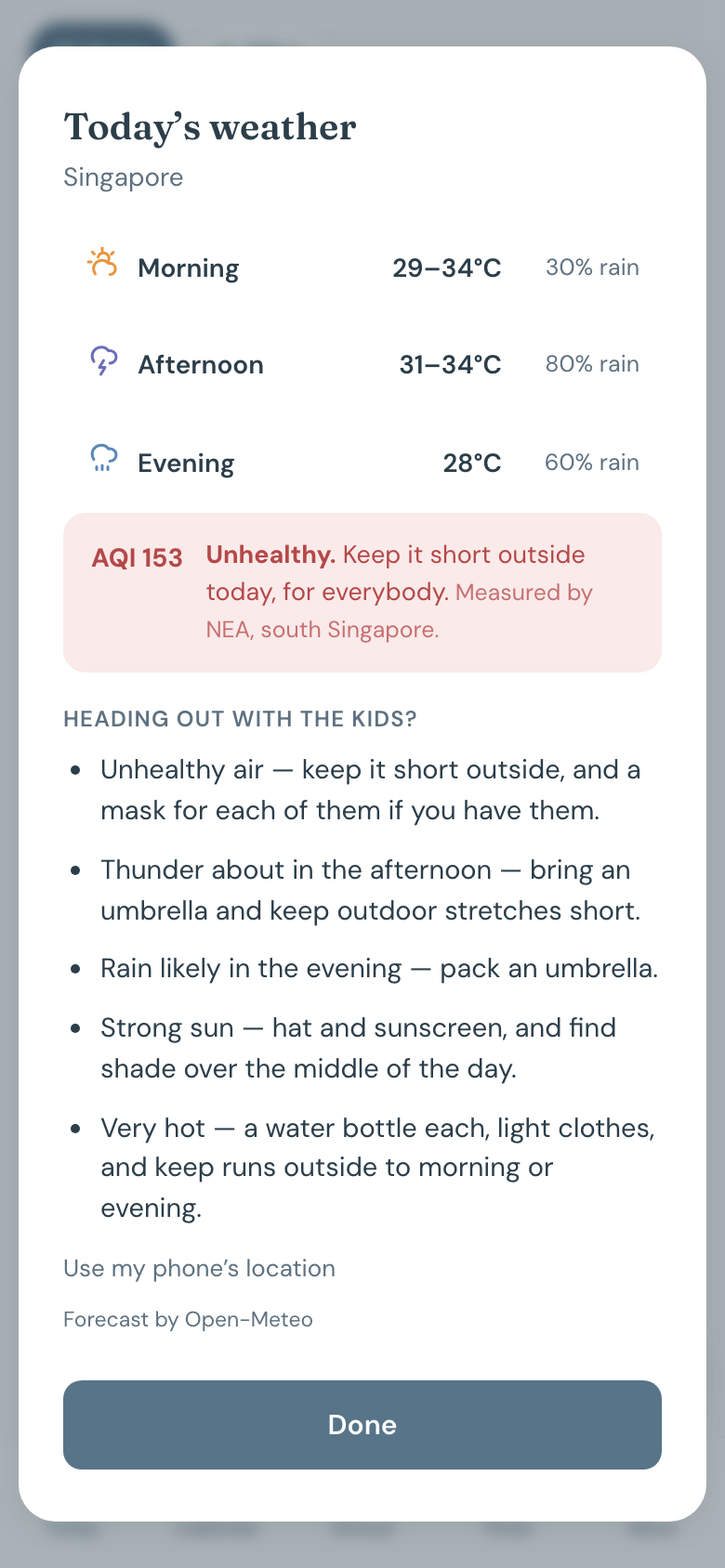
Chico uses the US air quality scale, the one from the Environmental Protection Agency. It has a band for the groups who are more affected by air quality than everyone else: children, older people, and anyone with asthma or a heart condition.
Most apps show that band under its official name, "Unhealthy for Sensitive Groups", which tells a parent nothing. In Chico it says not great for children, and the advice under it is written for you rather than for the general public. Small kids breathe faster than we do for their size, and they're the ones running around outside instead of sitting still, so the same air does more to them than it does to you.
What that means on a Tuesday: you cancel the park for a three year old at a lower number than you'd bother about for yourself. On that band Chico says cut back the running around. If it's one band up, keep any trip short. One more, stay in and shut the windows.
Underneath, "heading out with the kids?" leads with whatever today's actual problem is. On a hazy day that's the air, and it says keep it short and bring a mask each. On a normal day it's the thunderstorm at four, or the sun at midday.
That's what settles the morning's argument about whether it's safe to take them out. Not because Chico knows better than your mother does, but because you're both looking at the same sentence instead of guessing what a number means. Nobody has to go and look up a chart.
Two last things
Your childcare centre has its own rules. They follow their own haze guidance and they'll tell you what they're doing, which might not be what you'd have picked. Good to know before you plan a week around a pickup that's moved.
If anyone in the house has asthma, ask your doctor, not an app and not a blog post. A child with asthma may need to stay in on a day that's perfectly fine for everyone else. Ask their doctor what reading to keep them home at, and use that number instead of the one on the screen.