
It's 2am and your kid has a fever. You give her Panadol, settle her, and crawl back into bed. At 5am your partner hears her crying, picks up the bottle and asks, "Has she had any yet?" And you can't remember if that was one o'clock or three.
When more than one person is looking after a sick kid, keeping track of the medicine gets hard, fast.
How much to give is always a question for your doctor or pharmacist. This post is about the part after that: remembering what's gone in, when, and who gave it.
Why it's so easy to lose track
More than one person gives it. You give a dose at 7. Your mom gives one at 10, because nobody told her about the first. Nobody did anything wrong. The information was just in your head, and you were downstairs.
Your kid keeps growing. Medicine for small children usually goes by weight, not age, which is why the box isn't much help. HealthHub, the Ministry of Health's site, explains this on its children's medicine pages, and your doctor or pharmacist gives you the right amount for your kid. But toddlers keep putting on weight, and the number from the last check-up goes out of date without anyone noticing.
Two bottles can be the same medicine. Panadol and Paximol are both paracetamol. Give one and then the other, and it feels like two different medicines. It isn't.
Keeping track of medicine with Chico
Chico keeps your whole household's medicine record in one place, so nobody has to carry it in their head.
1. Set up each medicine once. In Health, add each medicine with the details your doctor or pharmacist gave you: the name on the bottle, the amount per kilogram, how many hours between doses, and the most allowed in a day. Then add your kid's weight, and Chico does the maths for you.
Chico never fills in these numbers. They always come from your doctor or pharmacist.
2. Log every dose. Each time someone gives a dose, they log it. Then Chico shows everyone:
- The amount for your kid's weight right now. No mental maths at 2am.
- The exact time the next dose is allowed, like 11:40, counted from when the last dose was actually given. If someone tries to log one too early, Chico tells them before it's saved.
- How many doses have gone in today. When the daily maximum is reached, Chico says so.
You, your partner, your mom and your helper all log to the same record. So it doesn't matter who's holding the phone.
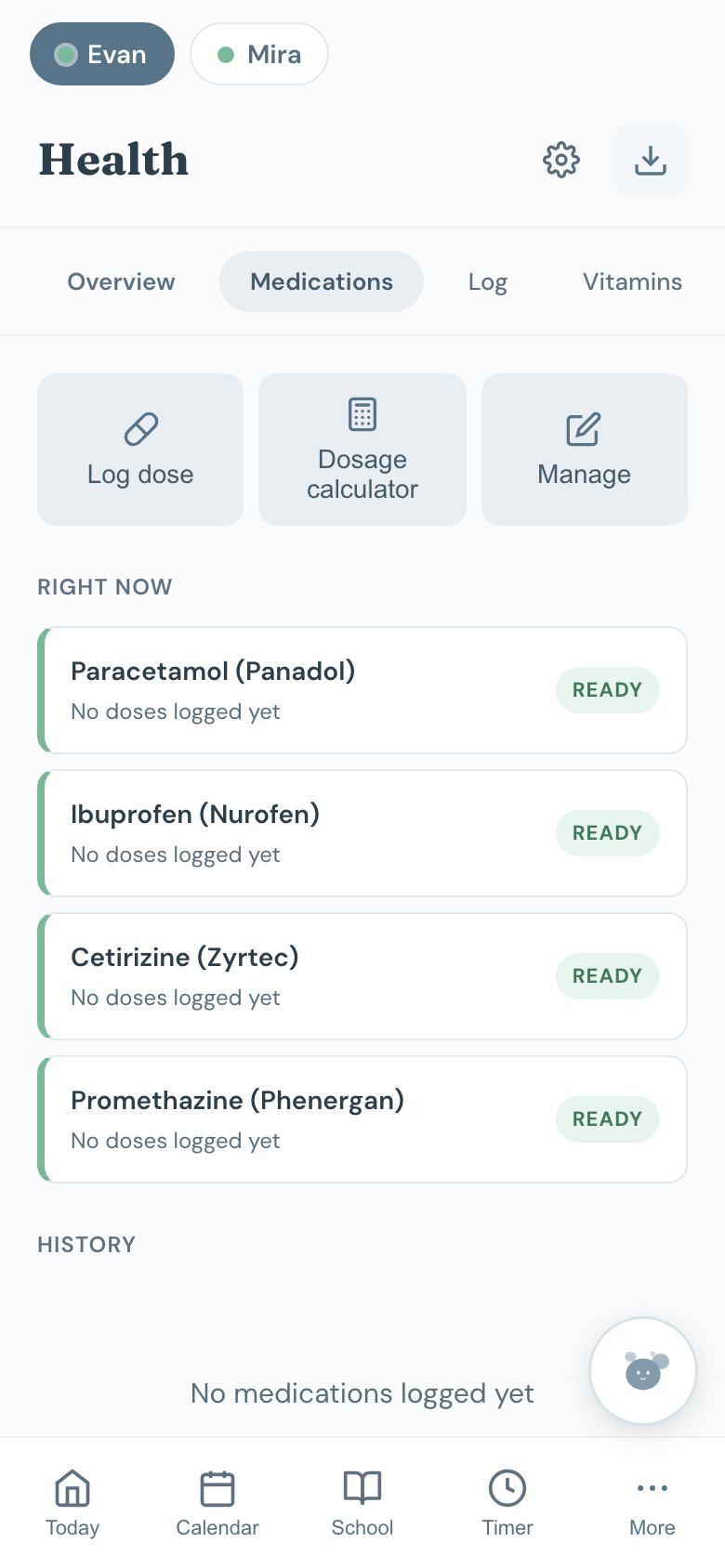
3. Tell Chico what's in the bottle. Each medicine has an optional box for the active ingredient. Type "paracetamol" for both the Panadol and the Paximol, and Chico counts them as one medicine when it works out the gap. If you only fill in one extra setting, make it this one.
What Chico won't do
For safety reasons, we don't build in a list of medicines or suggested amounts.
You type in the medicines on your own, from what the doctor told you, and then Chico helps you to remember from then on.
If you only do one thing
Ask your doctor or pharmacist once, and write down what they say. Then write down the time of every dose, somewhere everyone looking after your kid can see it. Even a piece of paper on the fridge does most of the job.
Chico is that piece of paper, except it comes with you, does the maths, and speaks up when it's too soon for the next dose.
And if you're ever unsure, call your doctor or pharmacist. In Singapore there's always a 24-hour clinic open, and asking is never the wrong call.